


The team at Overhype Studios is full steam ahead with the development of their new tactical strategy game, MENACE. Case in point: after briefly looking away, I came back to find a flood of new devlogs packed with fresh details on special enemies, operations, missions, and more.
So, I decided to consolidate multiple devlogs into this single, in-depth article that rounds up all the latest updates on the new title from the developers of Battle Brothers. Below, you’ll find links to the earlier devlogs, followed by all the newest dev diaries.
- How the Strategy Layer works.
- New details about the combat system.
- Information on weapons and their associated skills.
- Squad Leaders, Stats, Supplies, and Equipment.
- Suppression And Ship Improvements.
- How Perks And Promotions Work.
- The Pirate Faction.
- Action Points, Missions, Morale, Weather System, and more.
Dev Diary #15 Unveils Rogue Army Faction and Combat Strategies
Dev diary 15 for MENACE gives players an in-depth look at one of the game’s most unpredictable enemy factions—the Rogue Army. Unlike major political or military powers, Rogue Armies operate independently across the Wayback system, fighting for personal motives or regional influence. Each encounter against them plays out differently, making them a versatile and volatile threat on the battlefield.

Gameplay-wise, the Rogue Army prioritizes quantity over quality. Their ranks are made up of large, lightly equipped infantry squads, bolstered by a variety of heavy weapon teams including autocannons, mortars, machine guns, and rocket launchers. These squads rely heavily on overlapping fields of fire and mutual support but suffer from limited speed and poor maneuverability. Players are encouraged to isolate and dismantle units one by one, and to neutralize long-range threats early, especially with off-map abilities and targeted reconnaissance.
Notable units include Light Walkers armed with high-energy lasers, hulking assault howitzer tanks with devastating frontal cannons, and Supply Runners tasked with keeping heavy teams rearmed mid-combat. A new Officer unit also adds strategic depth, improving morale and movement speed across infantry formations. As expected, many of the Rogue Army’s weapons and vehicles will be usable by players as well.
With more weapon types promised in future updates, the Rogue Army faction looks set to become a cornerstone of MENACE’s tactical sandbox—brutal, chaotic, and completely unpredictable.
Dev Diary #16 Details Mission Prep and Tactical Deployment
Dev diary 16 dives into one of the game’s most vital systems: mission preparation and deployment. According to the team, battles can be decided before a single shot is fired, making pre-combat planning a critical part of the tactical experience.
Before launching any mission, players are shown a procedurally generated combat map that highlights mission objectives, deployment zones, structures, and terrain features. Environmental conditions such as weather and time of day also play a role; night missions, for instance, may require dedicated equipment or specialized squads.

Intelligence gathering is abstracted through a layered system simulating orbital scans, intercepted communications, and satellite feeds. Higher intel ratings reveal more about enemy unit composition and movement, helping players prepare for surprises like heavy weapons or mechanized threats.
Players must manage limited Supply Points, balancing how many squads to bring and how much gear—such as armor, heavy weapons, and vehicles—each unit is equipped with. Squad leaders bring additional strategic depth, influenced by prior mission injuries, perks, and even emotional state. These leaders can shift deployment strategies as well, with some perks allowing expanded or forward deployment, even behind enemy lines.
The diary reinforces MENACE’s core design: thoughtful preparation, layered systems, and meaningful decision-making long before combat begins.
Dev Diary #17 Goes Behind the Scenes of Development
The 17th dev diary pulls back the curtain on how the game is coming together behind the scenes, offering a look at what the team is currently building, from improved combat UI to vehicle customization and world-building efforts.
Concept Art and Combat Map Variety
First up, the team is working on armor variants, bringing not only visual diversity but also gameplay advantages like improved stats and bonuses. Alongside that, new battlefield structures, such as barbed wire that blocks infantry and tank barriers that halt vehicles, are being added to introduce more tactical depth to mission maps.

Combat UI Overhaul
The developers have begun implementing the second iteration of MENACE’s tactical combat UI. The goal: clarity without clutter, a tall order for a game with so many interlocking systems. This UI revamp is only now possible as the core mechanics have reached a more stable state. The final version is still evolving, but players can expect a more intuitive and readable battlefield experience.
3D Environment and Vehicle Design
On the 3D side, the team is creating new assets to make civilian settlements more visually distinct, breaking up environmental repetition. They’re also modeling a new light carrier chassis, capable of either troop transport or weapon mounting—though players will have to choose between firepower and mobility.
Modular Vehicle System
A major technical effort is being poured into reworking how vehicles are built and customized. The team is designing a modular system where players can swap weapons on vehicles based on available light, medium, or heavy hardpoints. It’s a challenging feature to implement due to the need for visual consistency between weapons and chassis, but the flexibility it brings should be worth the trouble.
Not all vehicles will be modular; unique units, such as the Rogue Army heavy tank, will still exist. However, for most, this system promises a wide array of player-driven configurations.
Dev Diary #18 – Operations: Connecting Battles with Purpose
One thing that’s become clear over the past months is that MENACE isn’t just about isolated missions; it’s about surviving the long haul. That’s where Operations comes in. Introduced as a way to give missions greater context, operations are structured, multi-stage campaigns that tie individual battles into a cohesive, branching storyline. And as you’d expect from MENACE, they’re procedurally generated.
What Operations Really Are
In simple terms, an operation consists of three to five tactical missions. They’re arranged in a branching structure, think of a tree where you choose one path per level. You can’t backtrack or complete multiple nodes at once. Every mission leads toward a final decisive engagement, but the route you take determines both your challenges and your rewards.

And here’s where things get serious: damage is persistent. Any injuries your squad leaders take, any destroyed vehicles, or spent resources all carry over until the operation is finished. You’ll get a full resupply and vehicle repairs at the end, assuming you make it. But permadeath is real. Lose a pilot or a vehicle chassis mid-operation, and they’re gone for good.
Succeeding in an operation rewards you with valuable OCI points, boosts your Authority (used to maintain order on your ship), and strengthens your trust with the local faction that issued the mission. Fail, and you lose out on all of that, though you’ll at least get to keep any rewards earned from completed missions along the way.
Strategic Choices: Assets, Rewards, and Enemy Perks
Each mission in an operation offers specific rewards, from promotion points and equipment to Strategic Assets, temporary bonuses that help throughout the rest of the operation. Some assets offer extra intel, some give you access to mortar strikes or support troops. But there’s a twist: enemy assets work the same way, just in reverse. A mission may grant you a powerful strategic asset, or let you disable one the enemy is using—but not both. These trade-offs become more prominent later in the game and force you to think ahead.
Missions also vary by type, biome, weather, and time of day—factors that all influence your deployment strategy. Choosing the right path through the operation isn’t just about the best reward; it’s about managing your risks and resources across multiple engagements.
Operation Example: Turn the Tide
To put it all into context, the devs shared an early operation called “Turn the Tide”, where players are deployed to halt a rapidly advancing Rogue Army. It begins with missions like Delay (holding ground to buy time), Stop Marauders (rescuing civilians), or Relief Outpost (breaking a siege). Middle-phase missions push deeper, with objectives like laying mines behind enemy lines, rescuing POWs, or defending key outposts.
And finally, you’ll face missions like Breakthrough, a full-frontal assault against fortified enemy lines, or Decapitation Strike, where the goal is to eliminate a key Rogue Army officer under heavy protection.
What stands out is how each operation offers a thematic arc, a mix of tactical decisions, and long-term consequences. No two playthroughs are exactly alike, and over time, more missions and operations will be added to keep things fresh.
Dev Diary #19 – Concealment, Detection, and Lines of Sight
In MENACE, staying alive often comes down to one thing: not being seen. While firepower certainly has its place, knowing how to position your squads to stay hidden and how to reveal the enemy before they see you can change the course of a mission. Dev Diary 19 digs deep into the visibility system, covering how concealment, detection, and line-of-sight work together to shape every engagement.
Vision Range: Seeing (and Not Being Seen)
Most infantry squads in MENACE have a base vision range of 9 tiles, meaning they can spot units that fall within that radius, lifting the fog of war. But not every unit sees equally.
- Infantry: ~9 tiles. Baseline for most troops.
- Vehicles: Lower than infantry. Their bulky optics limit their vision, especially close-range and at low angles.
- Walkers: Better than standard vehicles. They benefit from elevation, faster pivoting, and increased situational awareness.
Some heavy vehicles even have blind spots; an enemy crouched behind or below them might go entirely unnoticed.

Line of Sight: Predictability Over Realism
Unlike many strategy games, MENACE uses a streamlined line-of-sight system designed for clarity rather than strict realism. That means you always know when you’re visible—and when you’re not.
- Small obstacles (1×1 or 1×2 tiles) do not block vision or fire. You can shoot around them.
- Large obstacles (3×3 tiles or more) do block lines of sight and fire, using tile-based raycasting.
This abstraction ensures that cover works as expected. A squad pressed up against a small building can still peek and shoot, even if the animation doesn’t show it.
Cover, Concealment, and Detection
Being within a vision range doesn’t automatically mean you’re visible. Visibility depends on a balance between concealment and detection.
- Concealment reduces how far an enemy can see your unit.
- Detection reduces how well your unit can hide from the enemy.
Let’s break it down:
| Concealment Sources | Detection Tools |
|---|---|
| Cover (e.g. walls, forests) | Thermal optics |
| Terrain (e.g. tall grass) | Detection perks |
| Equipment (e.g. camo kits, infiltrator armor) | High-tech accessories |
So if you’re 9 tiles away from an enemy but have +2 concealment, that enemy effectively sees 7 tiles, and you remain hidden. MENACE also uses a clear UI overlay to show which tiles are visible based on your concealment, allowing you to plan ambushes with confidence.
Importantly, detection in MENACE is deterministic, not random. No dice rolls, no guesswork.
Shooting Breaks Concealment… Unless You’re Silenced
Fire your weapon from concealment, and you’re instantly visible. You’ll fade back into hiding at the end of your turn, but enemies will remember where you were and may blindly shoot or move toward that position.
The only way around this? Silenced weapons, which are rare and come pre-modded. Firing from the shadows with one of these means you remain completely undetected, even after the shot.
Example:
A Scout hidden in a forest 8 tiles from a tank fires a regular rocket launcher—now they’re visible to everyone nearby.Same Scout, same position, but using a silenced rifle—no one sees a thing.
This mechanic emphasizes patience. Sometimes it’s better to wait and let the enemy walk into a better kill zone. Opening fire too early can blow your entire tactical setup.
Key Takeaway: Ambush Smart, Survive Longer
MENACE rewards those who think like commanders. Know your unit’s vision range, exploit cover, stack concealment, and never send a vehicle unsupported into a potential ambush zone. A lone enemy with a rocket launcher in tall grass can end your tank’s life in one shot.
Dev Diary #20 Highlights Progress Across UI, Art, and Combat Systems
Overhype Studios, with MENACE Dev Diary 20, offers a detailed look at ongoing development efforts across various departments, from interface design and concept art to 3D systems and level generation.
Second-Generation UI and Tactical HUD
The team is currently implementing the second iteration of the game’s tactical combat UI and HUD. This new version aims to improve readability while presenting key information in a clean, uncluttered format—an essential refinement given the game’s layered mechanics.
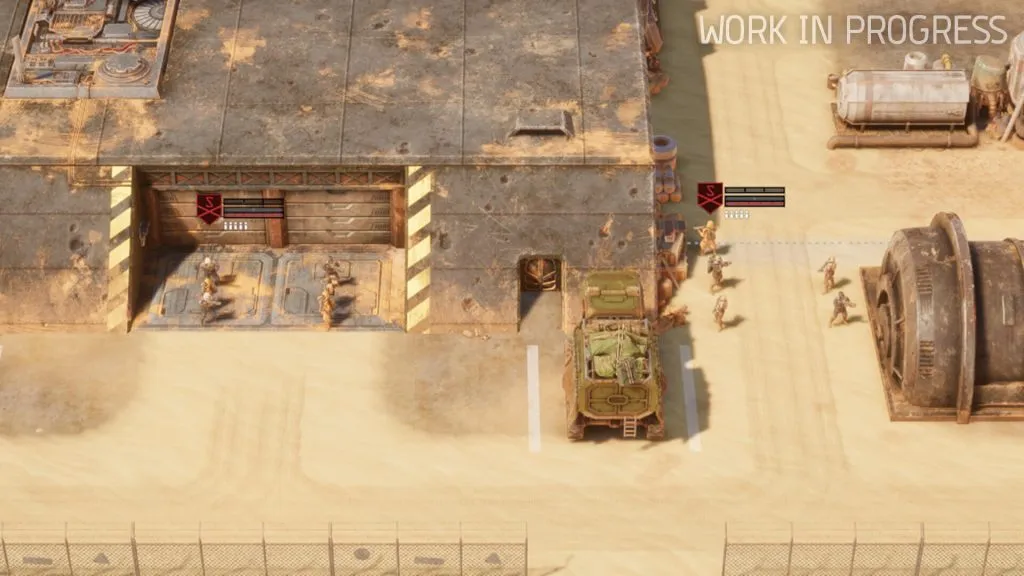
One key feature is the overhaul of unit icons, now inspired by NATO military symbology, allowing players to quickly identify unit roles at a glance. These improvements are also tied to preparations for a future combat demo.
New Squad Leaders and Biome Concepts in Development
On the artistic side, development continues on both character and environmental assets. More squad leaders are being implemented, with temporary placeholder artwork in place while final illustrations are completed. Each squad leader in MENACE features unique traits, perks, and personalities, reinforcing the game’s emphasis on handcrafted characters.
In parallel, early concept work is underway to create biome subtypes for the game’s planetary environments. One example shown is a “temperate” biome, divided into variants like highlands and marshlands. These biome distinctions are intended to add environmental variety and influence tactical engagements.
Expanded Operations and Procedural Mapping
Level design is currently focused on expanding the variety of operations available in the game. Each enemy faction will have multiple operations with distinct mission pools. A screenshot shared from the chunk system editor reveals ongoing work on defense line templates for the “breakthrough” mission type.
These templates are used to procedurally generate unique maps, maintaining a balance between handcrafted structure and replayable randomness.
Dynamic Vehicle Loadouts Taking Shape
On the technical side, the 3D department is finalizing the long-awaited dynamic vehicle weapon system. Once implemented, this system will allow players to fully customize vehicle loadouts by equipping different chassis with a wide variety of weapons. Inspired by the game’s flexible infantry system, the new vehicle customization will dramatically increase tactical options in combat.
Dev Diary #21 Answers the Most Frequently Asked Questions
And let’s close this article with the dev diary #21, where Overhype Studios offers answers to the most frequently asked questions from the community.
Early Access, Platforms, and Availability
MENACE is planned to launch in Early Access on PC via Steam later this year, though no open beta is planned ahead of time. The developers are exploring the possibility of releasing a combat demo before launch. Details regarding pricing are still under wraps, but the developers suggest looking at similarly scoped games as a reference. Steam Deck and GOG support remain undecided and will be handled by the game’s publisher, Hooded Horse.
The title will be fully playable offline, and around 80% of the game’s features are expected to be implemented at the start of Early Access.
Campaign Structure and Replayability
Unlike Battle Brothers, MENACE features a narrative-driven campaign with a definitive end. Players take command of a Republic Marine strike force deployed to the isolated Wayback system, where a growing threat, the MENACE, must be contained before it spreads beyond control. The campaign is expected to last 30+ hours per playthrough and combines fixed story beats with procedurally generated missions and operations.
Each operation consists of 3–5 connected missions with persistent consequences. Squad leader deaths, vehicle losses, and resource usage carry forward until the operation is completed or fails. While an endless sandbox mode is not currently planned, the procedural mission system and selectable squad leaders are designed to enhance replayability.
Squads, Characters, and Narrative Design
All squad leaders in MENACE are handcrafted characters with unique personalities, backstories, and voice lines. This design choice allows for persistent relationships and meaningful interactions between characters. Players begin with a roster of Republic Marines and later gain the opportunity to recruit characters from local factions.
While there is no support for custom or procedurally generated squad leaders, the game offers flexibility in perk trees, allowing for different builds in each campaign. The devs have also confirmed that permadeath is in place and that fallen characters will be gone for good, drawing comparisons to Jagged Alliance 2.
Tactical Mechanics, Combat Support, and Customization
The tactical layer of MENACE incorporates a wide range of systems, including permadeath, squad loadouts, terrain-based concealment, and customizable vehicle armaments. Off-map abilities such as air support, EMP strikes, and area scans play a key role in shaping engagements. Squad leaders can also bring tools like drones, mines, and motion scanners into battle.
Players will not be able to rename squad leaders due to their fully voiced roles in the narrative. Visual customization—such as armor and vehicle colors—may be added during Early Access. Loadouts, however, are fully customizable, and a modular vehicle weapon system is currently in development.
Mod Support, Community Tools, and additional Details
Steam Workshop support is planned for MENACE, allowing modders to create and share content. Additional sandbox or custom campaign tools are not currently confirmed, though the developers remain open to community feedback throughout the Early Access phase.
The diary also addressed frequently requested features such as cybernetics, squad bonds, narrative events, and legendary weapons. Many of these are still under consideration or may be introduced later in development. The team is also focused on delivering a high-quality sound design and voiceover experience, with more details on the game’s soundtrack to be shared in a future update.
MENACE is a character-driven tactical RPG with layered combat mechanics and strong replay value. For players looking for a more structured and story-rich alternative to Battle Brothers, it’s one to keep a close eye on as the Fall 2025 release window approaches.
There are already two more devlogs to cover, but I’ll include them in a follow-up article. I’m trying to keep these from getting too long and harder to read. See you next time! Ciao

