
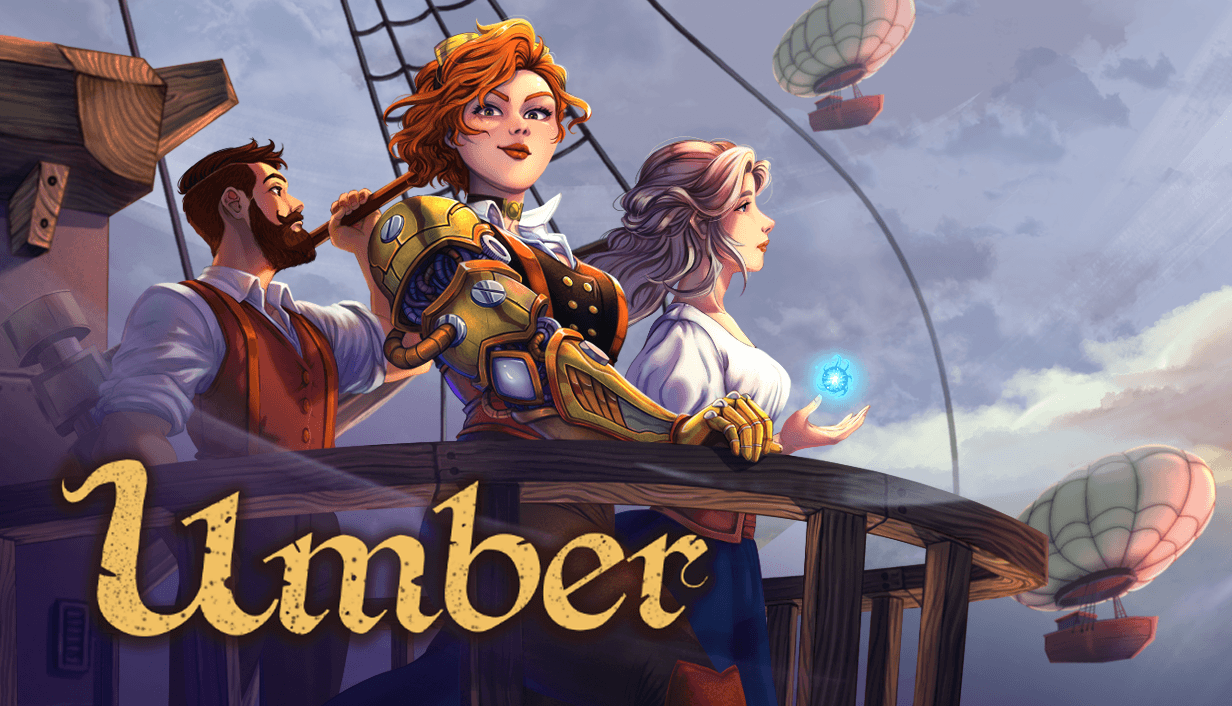
The upcoming Tactical RPG from Ink Studio Games rewards quick decisions with Impact Charges, offers up to 12 character classes, and turns a customizable airship into battlefield support.
Most turn-based RPGs allow players to study the battlefield for as long as they need. Umber takes a different approach. Completing turns quickly generates Impact Charges, a combat resource that can strengthen individual attacks or be saved to call down artillery from the party’s airship.

That mechanic sits at the center of an upcoming indie tactical RPG that immediately enters familiar territory for fans of Final Fantasy Tactics. Umber features isometric battlefields, grid-based movement, character classes, ability trees, and a party caught in the middle of a politically divided world.
However, its steampunk setting, speed-rewarding resource system, and upgradeable airship give the project several ideas of its own.
In Short
- Developer and Publisher: Ink Studio Games
- Genre: Tactical RPG
- Platform: Windows PC via Steam
- Release Date: Coming soon
- Key Features: Objective-based turn-based battles, Impact Charges, up to 12 classes, equipment upgrades, and airship customization.
Tactical Battles With More Than One Path to Victory
Umber’s combat takes place across isometric, grid-based battlefields where fights will require the party to defeat specific enemies, while others revolve around holding a location or protecting valuable assets.
Characters can attack opponents, strengthen allies with supportive abilities, and reposition units around the map.

The party must confront soldiers from neighboring countries involved in the ongoing war, alongside creatures known as the Breeched. These monsters originate from a twisted realm that has begun leaking into the world following the destruction of an ancient seal.
Although the overall structure will be recognizable to experienced tactical RPG players, objective-driven missions should provide room for different party compositions.
A durable team suited to defending a location may not perform as effectively during a mission that demands rapid movement, while offensive specialists may require additional support when civilians, structures, or other assets must be kept alive.
Fast Turns Generate Impact Charges
Umber’s most distinctive system is built around the speed of the player’s decisions. Finishing a turn quickly awards Impact Charges, creating a mechanical incentive to act efficiently and fast.
Impact Charges can be used to improve an attack by increasing its damage, accuracy, and critical-hit chance. This gives players a way to make an important action more reliable, particularly when missing an attack or failing to eliminate a dangerous enemy could disrupt an entire plan.

Players can store them and eventually request an airstrike from the party’s airship, the Icewind. That creates a straightforward but potentially meaningful resource decision: use a smaller number of charges to secure an immediate attack or preserve them for more substantial support later in the encounter.
The system also links the pace of individual turns to the wider tactical battle. Players who already know which abilities they intend to use will be rewarded for executing that plan quickly, while difficult situations may force them to decide whether careful consideration is worth sacrificing additional charges.
Build a Party Across 12 Character Classes
Party development will be organized around 12 different classes, each featuring its own ability tree. Players will be able to improve individual classes over time and assemble a team suited to their preferred approach to combat.
The complete roster has not yet been revealed, and it remains unclear whether every character can freely change classes, whether abilities can be carried between them, or whether certain party members are tied to predetermined roles.

Weapons and armor can receive both magical and mechanical modifications, with upgrades capable of increasing their power, adding resistances, or granting new abilities. The combination fits the game’s setting, where the remaining traces of magic exist alongside a rapidly expanding industrial society.
This equipment system also gives players more than one way to shape a unit. Class abilities define a character’s general battlefield role, while upgrades can reinforce that specialization or compensate for a weakness.
A frontline fighter might be equipped with additional resistance, for example, while an offensive character could gain access to another ability or improved damage.
The Icewind Is Part of the Combat System
Airships are a familiar sight in RPGs, but the Icewind is intended to be more than transportation or a location for story scenes. Players will be able to customize the vessel by modifying its deck layout, artillery, engine, and other components.
The Icewind can provide air support during ground encounters, meaning that upgrades made outside battle may influence the options available once a mission begins. Instead of developing only individual party members, players will also be strengthening a shared strategic resource that supports the entire group.
A World Where Industry Replaced Magic
Umber takes place in Evaria, a world once sustained by a magical force known as Aether. A cataclysm hundreds of years before the game’s story destroyed most of that energy and nearly wiped out the mages capable of controlling it.
As the remaining Aether gradually disappeared, magic faded from everyday life and eventually became little more than a legend for much of the population.

Civilization responded by embracing machinery. Gears, steam-powered technology, and industrial production replaced many of the functions once performed by magic, with the new inventions fueled by a recently discovered mineral called Umber.
The story begins in Vanmere, a country torn apart by war. Two factory workers, Molly and Henry, travel through the devastated countryside after encountering an eccentric stranger named Victor. He introduces them to Elizabeth, a young woman who is one of the last mages possessing genuine power.
Their meeting draws the group into a much larger conflict. An ancient seal created to contain a forgotten evil has weakened alongside the world’s disappearing Aether. When it finally breaks, creatures from a distorted realm begin entering Evaria.
Molly, Henry, Elizabeth, and their companions must form a party, bring Vanmere’s divided factions together, and uncover the world’s hidden history before the threat spreads further.
A Familiar Tactical Foundation With Ideas of Its Own
Umber clearly shares several qualities with the tactical RPGs that inspired it: isometric encounters, class-based party development, grid movement, and a war-torn fantasy world. Its identity, however, rests on how those familiar elements are connected.
Impact Charges turn faster decisions into a resource. That resource can be used to improve an individual attack or activate support from an airship that has its own customization system. Meanwhile, magical and mechanical equipment upgrades reinforce the conflict between Evaria’s fading past and its industrial present.
Several important details remain unknown, including the full class roster, the flexibility of the class system, the structure of the campaign, and the precise rules governing Impact Charges. The game also does not yet have a confirmed release date. In the meantime, you can wishlist it on PC via Steam. Below is the announcement trailer.
