
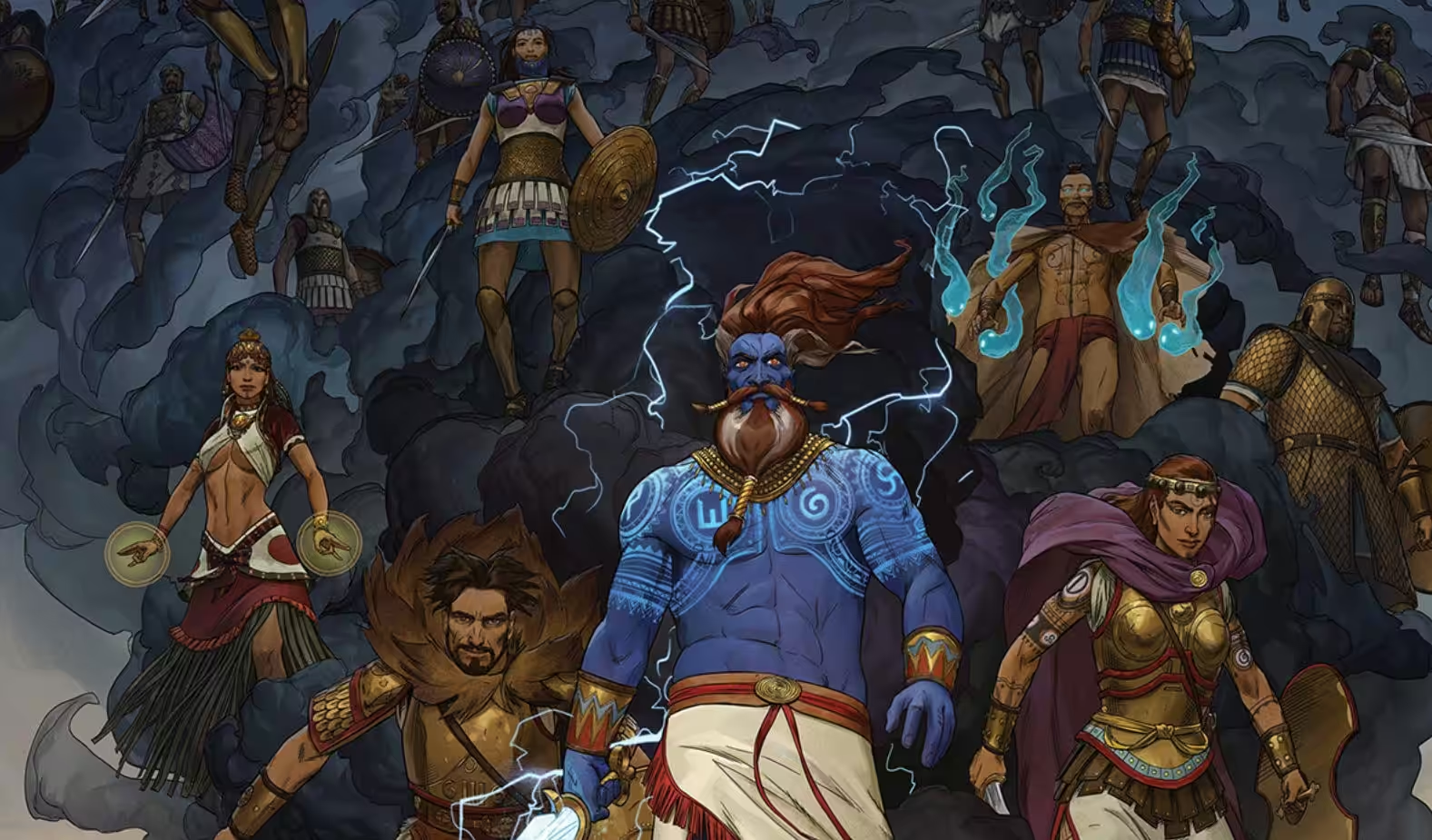
Is This RuneQuest… or Did Warhammer and Bronze Age Mythology Have a Baby on My Desk?
RuneQuest Warlords is the kind of tactics game that sneaks up behind you at 3 a.m., taps your shoulder politely, and then immediately suplexes you into the Bronze Age.
It’s a love letter to Glorantha, a boot to the ribs for anyone who thinks tactics games should be easy, and a perfect example of what happens when a tabletop RPG with five decades of lore wakes up one morning and decides it wants to become a digital war machine.
For transparency’s sake, I got a free key for this review, and things may change by launch, but what follows is exactly what I experienced: noisy battles, angry goatfolk, beautiful maps, and several dogs who died for my sins because I forgot zones of control existed.
And now that I’ve played it long enough to start involuntarily muttering the word “Orlanth” in the shower, I can confidently say this: RuneQuest Warlords might be the most gloriously chaotic Bronze Age tactics experiment I’ve touched in years.

The vibe slaps immediately. This isn’t “generic fantasy forest number twelve” with elves recycling dialogue they borrowed from a toothpaste commercial.
This is Glorantha—a myth-soaked, rune-carved, God-haunted world where storm cults scream themselves into battle and goat-headed raiders wander in with the energy of a drunk biker gang looking for the wrong wedding.
If you’ve played King of Dragon Pass or Six Ages, you already know the mood: ancient magic, tribal politics, cosmic grudges, lots of shouting, and the occasional spirit wind that rearranges your spine. RuneQuest Warlords takes all that chaos and funnels it straight into tactical encounters where your hero feels like a demigod one moment and an exhausted gym teacher the next.

Visually, the game nails a sweet spot I didn’t know I wanted. The maps are pretty without screaming, “WE USED ALL THE SHADERS.” Terrain is stylized just enough to feel like paintings come to life, and the lighting hints at a world where the gods might be judging you from behind the clouds.
Units are readable, expressive, and animated with enough flair that you always know when a goat-man is about to shove something sharp into your ribcage.
Everything feels intentional: the dusty bronze palette, the rough stone fortresses, and the banners flapping in the wind like they’re auditioning for a more expensive game. It doesn’t need fireworks. It just needs atmosphere, and it delivers.

The audio is the one area where I kept thinking, “Okay, this is good… but it could go harder.” Sound effects land, music simmers, spells pop, and steel clashes—all solid.
What’s missing is that iconic punch certain tactics games have, the sound that tells your brain, “Yes, that javelin absolutely ruined someone’s afternoon.” But the foundation is there. Layer on thunderous drums, some storm-god chanting that sounds like it was recorded three thousand years ago, and a bit more bass on the rune abilities—and it’ll sing.
But let’s talk mechanics, because this is where the game puts on its war paint. RuneQuest Warlords is a hybrid beast—part turn-based tactics, part warband management, and part Bronze Age fever dream.
You command a hero and their attached troops. The hero is your superstar, your quarterback, your magical linebacker. They get extra action points, rune abilities, the ability to leap across the battlefield like a divine grasshopper, and enough wind-based spells to blow half a village into the ocean.
Meanwhile, your household warriors, militia, and war dogs form the backbone of your line and are doing all the dirty work while the hero steals the glory.

Zones of control matter. Facing matters. Terrain matters. If you misposition by a tile, expect pain. If you tunnel-vision on one flank, the enemy mage in the back will turn your militia into charcoal. If you forget the dogs are fragile, they will evaporate like soufflés left in the rain. The AI understands when to push, when to surround, and when to snipe your favorite unit just to emotionally injure you.
One mechanic that deserves a standing ovation is Battle Rush—the divine hype meter of Glorantha. Every time you hit hard, kill something, or generally behave like a menace, your troops build momentum.
Hit max rush, and your faction’s rune trait kicks in, turning your units briefly into mythic action figures. Suddenly, your forces gain extra actions, bonus power, or wind-infused murder opportunities.
It creates this beautiful tension between aggression and caution: do you charge like a lunatic to trigger rush early, or do you hold formation, terrified the enemy might hit their peak first and turn into a blender with hooves?

Army management between missions brings the tabletop DNA fully into view. Troops gain veterancy and become emotionally significant, which makes it more painful when they get deleted because you misread the enemy’s focus haze.
Fame tokens let you upgrade your hero with ridiculous abilities—extra movement, better armor, rune powers that buff your whole army, and leaps so dramatic they should come with slow-motion cameras.
Reinforcing your warband becomes a constant balancing act: do you bring in fresh militia, upgrade your veterans, or stuff your reserves with backup dogs like some medieval Noah preparing for the worst?
Campaign missions are handcrafted and varied. You’ll be defending burning homesteads, rescuing trapped households, climbing fortress walls, shutting down gate mechanisms, and smashing raiding parties so numerous they feel procedurally generated by a mischievous goat deity.
One mission had me leaping my hero into a cluster of mages while my dogs flanked left, my javelins rained down, and my militia overwhelmed a shield wall—and for a moment, I felt like the conductor of an ancient, rune-powered orchestra of violence. Then the next mission I forgot to rotate my hero before ending turn and everything went to hell. Balance restored.

Combat flow is satisfying and punishing in equal measure. Most units have a single action, but heroes get two, letting them chain combos in ways that make you feel strategically brilliant right until the moment you realize you put them in range of three angry marauders with nothing left to disengage.
Rune powers feel powerful without derailing the turn economy. Storm blasts shove enemies across the field, divine winds buff your entire warband, and empowered attacks turn your hero into a Bronze Age chainsaw.
When everything clicks—when your leap lands perfectly, your javelins find their mark, your militia flanks, and your battle rush spikes—it feels sublime. When it doesn’t click, you stare at the “unit permanently dead” screen as you’ve just lost a childhood pet.

UI deserves praise. Slick, readable, intuitive, and mercifully free of the “let’s hide stats in submenus” disease ruining half the genre.
The overhead tactical map is a godsend for parsing objectives mid-battle. Facing indicators, hazard tiles, focus hatching, and movement previews—everything is quick and clean, which is exactly what you need when goatmen are two turns away from turning your warband into compost.
Replayability looks strong. Between factions, runes, hero upgrades, army compositions, and maps that encourage wildly different tactics, RuneQuest Warlords feels like a game that could support multiple campaigns without going stale. If the developers add more scenarios, factions, or mythic enemy types—and Glorantha has enough lore for a decade of expansions—this could absolutely become a long-term strategy staple.
And the setting elevates everything. Most tactics games treat lore like a garnish; here, it feels like the main course. Storm gods, runes, cult abilities, Bronze Age aesthetics, tribal politics, mythic themes—it all blends into a world that feels alive.
The goatfolk aren’t just monsters; they’re tied to the cosmology. Your hero isn’t just a commander; they’re a demigod in training. Even the javelins feel like they’ve killed at least three minor spirits on the way to the battlefield.

So, where does all of this land? RuneQuest Warlords isn’t trying to out-XCOM XCOM or out-Warhammer Warhammer.
It’s carving its own lane: a crunchy, atmospheric, Bronze Age tactics game full of personality, clever mechanics, and enough mythic flavor to choke a priest. It’s confident. It’s stylish. It’s occasionally infuriating. It’s deeply satisfying. And it has that special something—that “one more mission before I sleep” curse that ruins your morning meetings.
As a final note, yes: I got a free key for this game. Yes, things may change between now and release. And yes, every war dog that died in my campaign deserved better. But RuneQuest Warlords? It’s got something. Something sharp. Something stormy. Something that hits the exact sweet spot between tactical precision and pure chaotic myth.
And if the goatmen rise up on launch day, I’m blaming them for everything.
