

The late 90’s and early ‘00s were a tough time for international fans of Japanese RPGs. Since the genre was still a small niche, not every game got localized. Even big publishers like Square and Nintendo didn’t translate every game they made. These days, almost every game gets localized into multiple languages, but many older titles have slipped through the cracks.
Before the Fire Emblem series exploded in popularity, tactical JRPGs were an even more obscure niche within a niche. For every crossover hit like Final Fantasy Tactics, many other games never got an overseas release. As a result, there’s a surprisingly deep and diverse back catalog of Japan-only tactical JRPGs.
Not all the games in this list are necessarily forgotten classics, though I think you could make that case for some of them. If you look past the better-known games in this subgenre, there’s all kinds of weird and interesting stuff, from missing sequels to experimental obscurities.
There’s always hope that some of these games might get a modern re-release, as we saw recently when Square Enix dropped a surprise remaster of Torneko’s Mystery Dungeon on us. In the meantime, thanks to the efforts of dedicated fan translators, it’s easier than ever for players who aren’t fluent in Japanese to try them out.
Tear Ring Saga
- PlayStation
- 2001
- Tirnanog
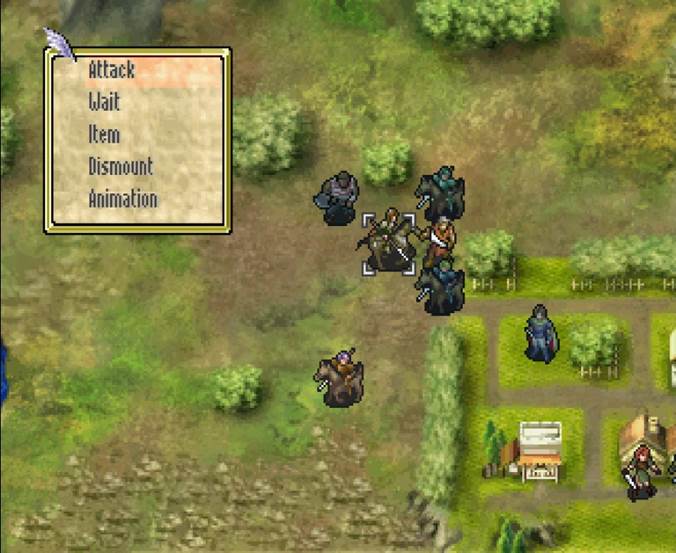
Old-school Fire Emblem fans will feel right at home with Tear Ring Saga, since it is essentially a Fire Emblem game in all but name. It’s not uncommon to find tactical RPGs that show clear influence from Intelligent Systems’ long-running series, but no other game has replicated the formula quite as authentically, since Tear Ring Saga is a Fire Emblem clone made by Fire Emblem’s creator.
After leaving Intelligent Systems, Shouzou Kaga set up his own studio and kept on doing his thing. His efforts were so consistent that they got the attention of Nintendo’s dreaded lawyers. The developers of Emblem Saga had to come up with a new name, and even that didn’t end their copyright troubles.
Regardless, the game shipped in 2001, and despite its new, legally distinct title, Tear Ring Saga was unmistakably a Fire Emblem game at its core.
Visually, Tear Ring Saga stays close to its roots, with small-scale sprites on the battlefield and side-scrolling battle scenes that show the outcome of your decisions in greater detail. Tear Ring Saga’s battle sprites are larger and more detailed, and the battle maps forgo the traditional tile-based environments in favor of a more painterly, impressionistic visual style.
Tear Ring Saga’s gameplay largely follows the formula of early Fire Emblem titles: you control a band of noble knights, mages, and soldiers who travel around the world map, engaging in wide-ranging tactical battles. These encounters give you a chance to either grow your army by befriending some non-player characters, or drastically reduce its size through tactical blunders thanks to the game’s mandatory permadeath mechanics.
If you’re looking for more classic Fire Emblem gameplay, then Tear Ring Saga delivers exactly that in all but name, with solid tactical battles, tried-and-true game mechanics, and tons of characters to recruit.
Ningyo no Rakuin
- PlayStation
- 2000
- Highwaystar
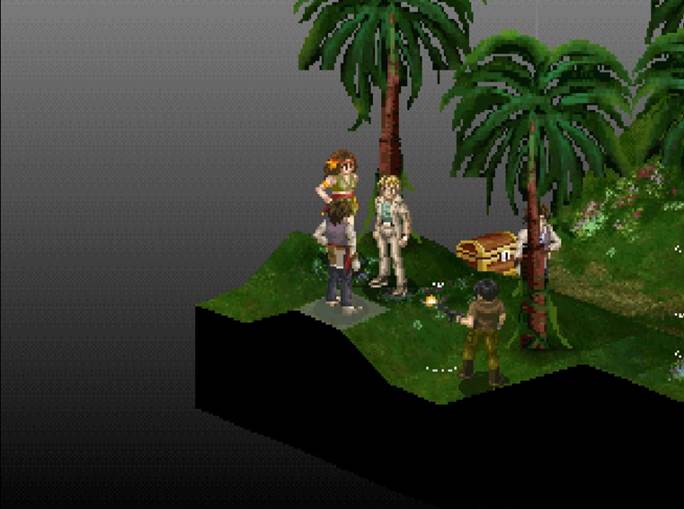
This otherwise straightforward PlayStation TTRPG trades fantasy tropes for Lovecraftian horror in a modern-day setting. In Ningyo no Rakuin (or, in English, Mark of the Mermaid), three Japanese high school students survive a plane crash onto a mysterious island. They quickly discover that the island is full of murderous cultists and aquatic monstrosities straight out of the Cthulhu mythos.
Like Final Fantasy Tactics and Vandal Hearts, Ningyo no Rakuin uses 2D sprite characters in a low-poly 3D map with an orthographic camera. The game follows a mostly linear structure, consisting of tactical battles interspersed with story sequences throughout its runtime. There are a couple of branching paths and multiple endings, but no towns or shops. The battle system itself is simple, but competently executed. There’s no complicated character growth system, since your party members just learn new abilities as they level up.
The simple gameplay and linear narrative make Ningyo no Rakuin fairly accessible to non-Japanese speakers, but the language barrier still makes the story hard to follow. Thankfully, it seems like an English fan translation is in progress as of last year.
Valkyria Chronicles III
- PlayStation Portable
- 2011
- Sega
Valkyria Chronicles III isn’t a major departure from the series formula, but no other JRPG series looks or plays quite like a Valkyria Chronicles game. While the rest of Sega’s anime wargaming series is available overseas, the third entry never made it out of Japan.
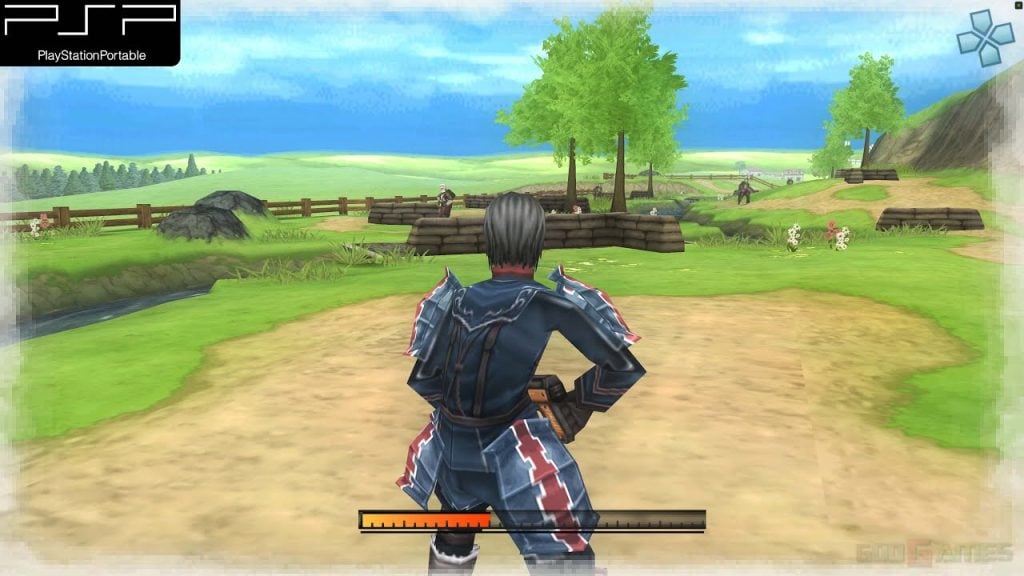
Valkyria Chronicles takes place in a fantasy world modeled after mid-20th-century Europe, amid a conflict roughly analogous to World War II. The gameplay combines tactical wargaming with semi-real-time shooting. Activating a soldier from the battle map switches the game to a 3rd person view where you can run around freely and target enemies in your line of sight. Your troops have a stamina gauge that depletes with every step, and once it runs out, they’re stuck until you activate them again.
While an active unit moves, enemies in range automatically take shots at them, like a weaker, simplified version of X-Com’s overwatch action. The real-time movement adds an element of tension to the game, but it plays more like a classic tabletop wargame than a shooter. Even with the rather forgiving enemy AI, success requires you to have a firm grasp of concepts like positioning, line of sight, and your individual soldier’s stats.
The story, which runs parallel to the original game’s events, is darker and edgier than the rest of the series. You play as Kurt Irving, a seemingly strait-laced, precocious young officer who gets put in charge of the “Nameless,” a penal unit that only gets the dirtiest, most dangerous assignments in the army.
Valkyria Chronicles III builds directly on the foundation of its immediate predecessor, which was also developed for the PlayStation Portable. As expected for a portable game, the production values aren’t as high as the home console titles. The maps and unit counts are pretty small. However, even in its portable entries, the Valkyria art style, with its watercolor-inspired textures and line drawing post process effects, holds up remarkably well.
If you enjoyed any of the previous games in the series, Valkyria Chronicles 3 offers more of the same engaging gameplay with a grittier narrative. Fan translations are available in Spanish and English.
Bahamut Lagoon
- Super Famicom
- 1996
- Square
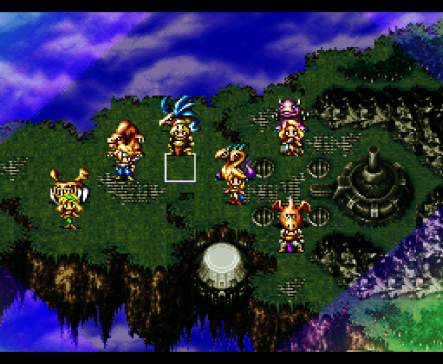
A late entry into Square’s 16-bit library, Bahamut Lagoon was directed by Final Fantasy 7 writer Kazushige Nojima. Bahamut Lagoon actually started development as a Final Fantasy spinoff under the name Final Fantasy Tactics. Development on Bahamut Lagoon started in 1994, a year before another Square team got to work on the “real” Final Fantasy Tactics for the PlayStation.
Even with the name change, Square’s well-known RPG franchise is all over Bahamut Lagoon. It is, after all, a game of grid-based combat against an evil empire in a magical world of floating islands. Final Fantasy’s recurring draconic big cheese even shows up in the game’s title and on the cover art.
Those similarities aside, Bahamut Lagoon is its own beast, and it doesn’t play much like its almost-namesake. Where character customization played a central role in Final Fantasy Tactics, Bahamut Lagoon’s gameplay focuses on unit composition and the tactical battles themselves.
Instead of individual soldiers, the units on the battlefield represent groups of four soldiers. When you attack another unit, the two parties square off in a familiar turn-based RPG battle. The large number of combatants gives Bahamut Lagoon’s combat a sense of scale that’s hard to find in other TTRPGs.
Each of your squads can also include a dragon that accompanies them in battle. You don’t control the dragons directly, but you can give them orders that the AI mostly follows. By feeding a dragon equipment, you can evolve them into new and more powerful forms.
Square Enix has never re-released or localized Bahamut Lagoon, but fan translations are available in English, Spanish, and Portuguese. It’s well worth a try for fans of Final Fantasy, or 90s Square RPGs in general, or anyone looking for a different take on TTRPG gameplay.
Majin Tensei
- Super Famicom
- 1994
- Atlus
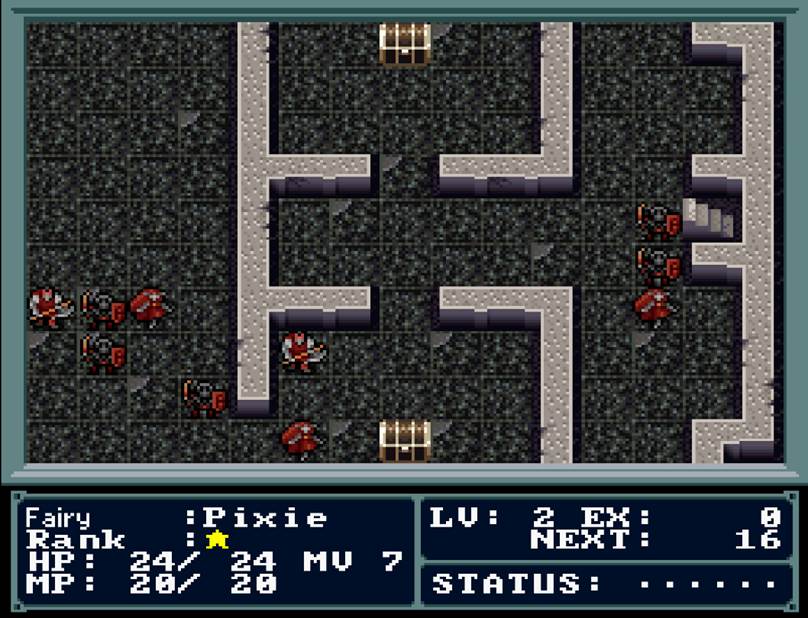
For fans who can’t get enough of the Shin Megami Tensei games, and who already played the excellent Devil Survivor games for the Nintendo DS, this early Super Famicom tactics game may be worth a look. The slow, occasionally tedious gameplay and primitive graphics may put off some players, but Majin Tensei retains the classic SMT vibes along with a compelling fusion of tactical combat and SMT’s familiar monster-collecting mechanics.
Like the other early SMT games, Majin Tensei focuses on gameplay over story. The initial setup is, at a glance, almost identical to other SMT games of the era: demons invaded Japan and made a mess of things, and your nameless hero, armed with a mysterious demon-summoning computer program, has to take them on.
Majin Tensei combines grid-based tactical battles with the core demon summoning mechanics of Shin Megami Tensei I and Shin Megami Tensei II. Like those games, when you meet an enemy on the field, you can either attack them or try to negotiate, which involves navigating a short dialog tree and trying to pick answers that the enemy likes. If you succeed, the demon joins your team.
Deciding whether to negotiate or go on the offensive adds an interesting element of risk to the game; you can always use more allies, but failed negotiations put you in danger and waste your turn. If a demon dies in battle it’s gone for good, so there’s a kind of revolving door dynamic to your party roster.
Energy Breaker
- Super Famicom
- 1996
- Neverland Company Inc.
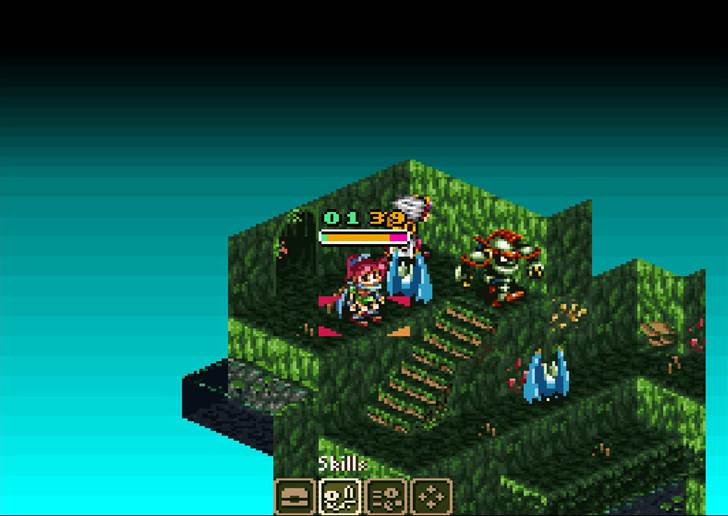
Tactical RPGs often frame their gameplay in epic stories of grim warfare. Energy Breaker stands out for its lighthearted story and energetically goofy yet stylish anime characters, designed by Yasuhiro “the Trigun guy” Nightow.
Players familiar with Neverland’s other work, especially Lufia II, might have an idea what they’re in for. Energy Breaker is kind of a stealth prequel to the Lufia series, though the connections between them amount to a few subtle references that might go over most players’ heads.
Energy Breaker uses an isometric view similar to Landstalker or Super Mario RPG. Between combat encounters, you’re free to wander around the world, buying items and talking to townsfolk like any other JRPG. The game’s levels make good use of vertical space both in and out of combat, a relatively rare thing for tactics games of the era.
Despite the invitingly cheerful art style, Energy Breaker’s combat can be pretty challenging and obtuse. The “balance point” system governs how many times your characters can move, attack, and use items or abilities. To succeed in combat, you have to be careful not to overextend yourself, all the more because balance points are tied to your health. The more damage you take, the fewer balance points you get at the start of the next turn.
Facing is also a critical thing to consider, since characters always counter when attacked head-on. You need to pay attention to where your units end up facing after a move and try to cover their backs as best you can.
It’s a flexible and interesting combat system, though the lack of in-game tutorials common for the time, combined with the weird system for learning abilities and the rather clunky interface, does hold it back. Energy Breaker’s visuals are about as bright and colorful as a mid-90s 16-bit RPG can get, and Nightow’s character portraits are full of personality.
Front Mission 5: Scars of the War
- PlayStation 2
- 2005
- Square Enix
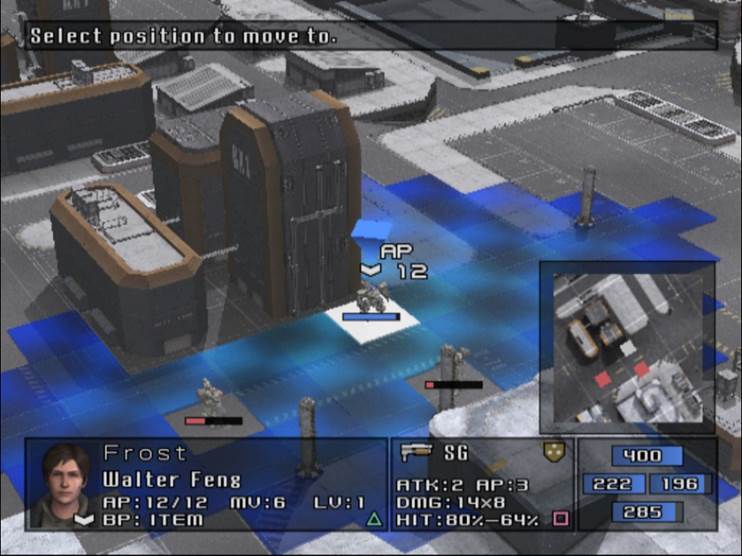
Front Mission is a venerable turn-based mecha series that started on the Super Famicom back in the 1990s, though its first international release was Front Mission 3 for the PlayStation.
Since then, most of the main series has been localized in some form. Sadly, that’s not the case for the most recent mainline entry in the series: 2005’s Front Mission 5: Scars of the War. The latest Front Mission tells a wide-ranging story that ties together plot threads across the entire franchise, including its online and mobile games. It’s like if Kingdom Hearts 3 featured grim modern war stories, giant bipedal tanks, and no official English script.
Front Mission 5 largely follows the classic series gameplay formula: you follow a linear story campaign, customize your team of mechs with an array of weapons and modular parts, and engage in extensive tactical missions where you use those mechs to blow up enemy pilots.
Although it’s probably not the best starting point for new players, the whole series is well worth checking out for tactical game players looking for a consistent series to dig into. The mainline Front Mission games feature solid tactical combat, fun unit customization options, and a gritty, real-world-adjacent setting that sets them apart from the usual fantasy fare.
Fortunately, a 2009 English translation made Front Mission 5 unofficially available, at least to English-speaking players.
Ecsaform
- PlayStation
- 1999
- Bandai Visual
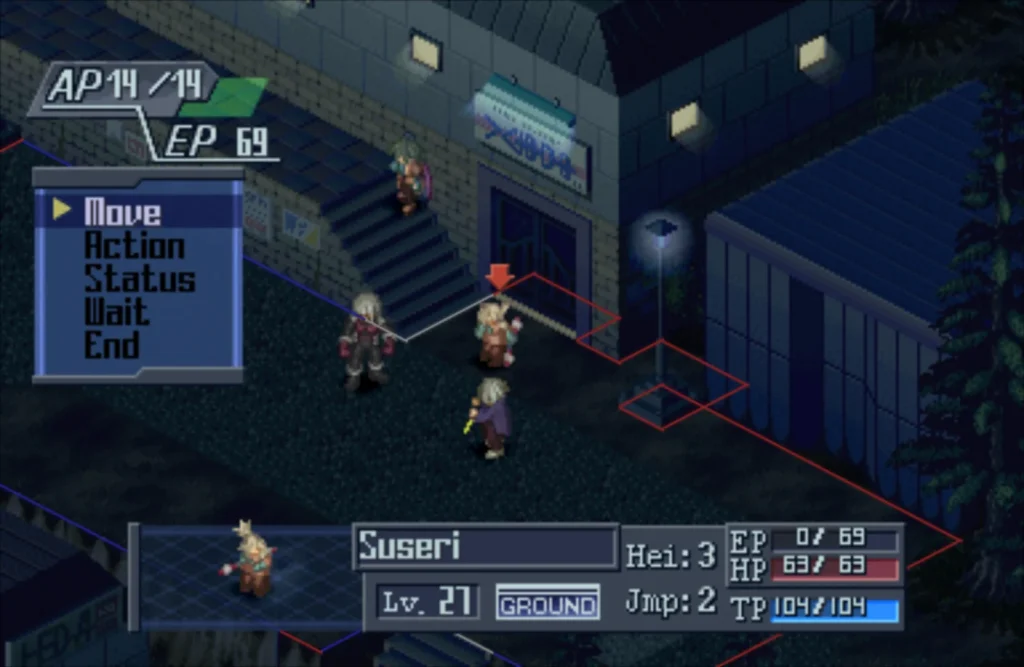
An obscure and quirky sci-fi tactical RPG, Escaform is the kind of game that throws you into the deep end and expects you to keep up.
Ecsaform’s narrative follows a pair of escaped test subjects on the run from a sinister researcher attempting to exploit their supernatural abilities. Once it gets going, the story is fairly engaging, with a unique and detailed world. Evocative character designs by renowned anime veteran Seiji Tanda do the heavy lifting here in establishing Ecsaform’s identity.
As is the case with Energy Breaker Ecsaform lets you run around the world freely between battle sequences. Once you run into an enemy, the game seamlessly transitions into combat mode.
One of the most interesting aspects of Ecsaform is how it handles the action economy. Each party member has an AP meter that they spend to move, attack, or use items and skills. You can spend it all to do lots of actions, but any AP you don’t spend converts into EP when your turn ends. EP essentially works as damage reduction; whatever damage an enemy attack deals has to go through the target’s EP before reducing their HP.
Since the player characters are relatively fragile early on, they need as much EP as they can get to survive more than a couple of hits. The result is a system that feels slow and punishing at first, but once you get used to it, managing your party’s EP and AP balance leads to engaging combat that rewards careful, methodical play.
Ecsaform won’t be to every player’s taste, but if you have the patience to look past some heavy setting-specific jargon and occasionally clunky gameplay, there’s plenty to enjoy here.

