


On December 18th, 1987, Hironobu Sakaguchi and Square Enix released Final Fantasy and permanently changed the landscape of turn-based RPGs. Before the smashing success of Final Fantasy, JRPGs had little foothold in the Western world, acting as little more than a niche genre loved by enthusiasts of Japanese gaming.
Consequently, the cliché mechanics and story beats of JRPGs (that as a gigantic fan of the genre, I like to call JRPG nonsense), became an increasingly present force in video games, as Final Fantasy’s presence and reach became increasingly apparently across the industry.
From fighting god with the power of friendship, class/job systems that come with a magical girl Sailor Moon outfit change, unlocking new ways to traverse the world (typically in the form of a land rover, boat, and airship in that order), and *shudders* fishing minigames, here are the top 7 turn based JRPGs you should check out if you need to experience as much JRPG nonsense as possible.
7. Enchanted Arms
Reminds me most of: Final Fantasy X, Final Fantasy XII

A rare departure from the Souls-like formula for FromSoftware, Enchanted Arms is a 2006 JRPG centered on Atsuma, a student studying to be an enchanter with (unsurprisingly) an enchanted right arm. When skipping his classes with his totally NOT doomed by the narrative best friends, the unlucky trio discover that the wards protecting the school from this world’s flavor of fiend (golems) have failed.
After a brief encounter with a powerful main antagonist, a Devil Golem named The Queen of Ice, Atsuma finds out his right arm is enchanted and is one of the few things that can actually harm these magical creatures. His friends predictably get captured/defeated, so Atsuma must go on an adventure to hunt down the Queen of Ice and be the hero of the narrative.
This has all the usual suspects you’d expect to find in a game like this: magic, a sarcastic and food loving Chosen One main character (and FromSoft’s version of Tidus from FFX), the royalty of the land being evil conspirators with the Devil Golems, random encounters, and convoluted storylines filled with Proper Nouns that are never fully explained outside of the codex.
While the grid-based combat system and voice acting leave a lot to be desired, if you are looking for a fun and unique game that scratches the JRPG itch, you can do a lot worse than Enchanted Arms.
6. Triangle Strategy
Reminds me most of: Final Fantasy Tactics, Final Fantasy XVI

One of the least JRPG-y games on the list, this game still checks many of the Final Fantasy checkboxes. Set in the fictional continent of Norzelia, Triangle Strategy follows the (soon to be named) heir of Glenbrook, Serenoa Wolffort, and his close inner circle of advisors as they navigate a conflict extremely reminiscent of Game of Thrones.
Triangle Strategy boasts a beautiful “2.5D” art style, and its gameplay is driven by a snappy and deceivingly complex grid-based tactics system. What makes the gameplay unique is the sheer number of unlockable characters – 30 of them!
Each playable character feels distinct from one another and fills a different niche, from the young girl circus performer who focuses on making body doubles and tossing offensive items long range, to the literal sentient barrel automaton. You are guaranteed to find a character you enjoy playing with and a party composition that works for your play style.
The story also features a branching narrative, determined by the Scales of Conviction system. Throughout the numerous (and sometimes too long) cutscenes, the story plays out, and you end up making consequential decisions with your inner circle of advisors. Because Serenoa is an Eddard Stark-esque character, the decisions are completely decided on by his inner circle, whether it’s what you want to do or not.
You can sway these advisors one way or another using both dialogue choices and a hidden “convictions” system, in which you earn points throughout the story, morality, liberty, and utility. Having a high amount of these stats allows you to more easily sway your jury to the decision you want and steer the story in the direction you choose.
I personally never had the inner circle decide against what I was aiming for, so I felt it was easy to make the story go how I wanted, granted that I was paying attention and locked into what’s going on in Norzelia. Overall, if you want a good grid-based tactics game with medieval Final Fantasy flavor, Triangle Strategy is the choice for you.
5. Fire Emblem: Three Houses
Reminds me most of: Final Fantasy Tactics, Final Fantasy IX, Final Fantasy XVI
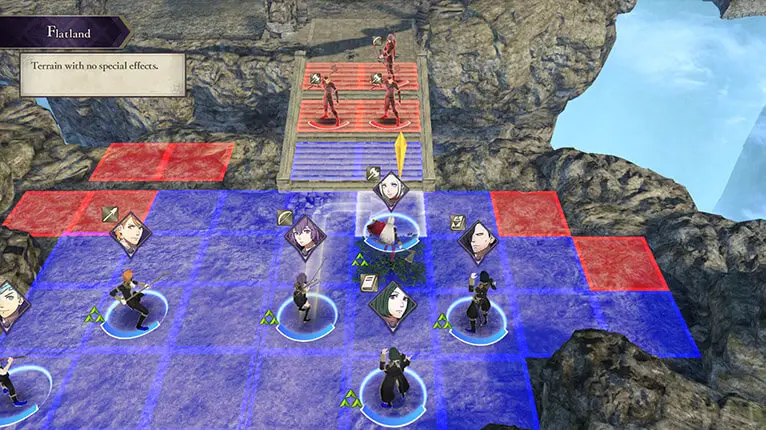
One of the best game releases of 2019, Fire Emblem: Three Houses, was my first introduction to the Fire Emblem series, and I was not disappointed. FE:3H is another medieval fantasy grid-based tactics game that is set on the fictional continent of Fódlan, currently divided between 3 ruling powers: the Adrestian Empire, the Holy Kingdom of Faerghus, and the Leicester Alliance.
You play as the child of a mercenary, named Byleth by default, who is tasked with rescuing the three heirs of the three ruling kingdoms from a bandit attack. After your impressive display, your father is hired as a knight of the Church of Seiros, and you are hired as a teacher at their school for nobles, Garreg Mach Monastery.
Throughout the game you choose a house to be the homeroom teacher of (and will subsequently side with during the impending war) and spend your school year building your relationship with the students, recruiting other students to your class, improving their battle technique, participating in choir practice, cooking meals together, and of course, fishing in a minigame.
While Fire Emblem: Three Houses has more player choice and customization than most Final Fantasy games, the story is extremely reminiscent of something you would find in one of the medieval-based games. The characters are all unique from each other and have surprisingly deep personalities and emotions that left me enamored with the game.
The gameplay is, again, a grid-based tactics strategy game, but with permadeath and many spells and skills that make it so much more satisfying than most other iterations of this genre. Fire Emblem: 3 Houses may not play like a traditional final fantasy game (and is more akin to final fantasy tactics than anything), but the story is absolutely brimming with JRPG tropes and nonsense, and any final fantasy fan will find themselves immediately transported to this fantasy world and picking sides in this political intrigue filled tale.
4. Metaphor Refantazio
Reminds me most of: Final Fantasy XII, Final Fantasy V, Final Fantasy XV

My personal 2024 game of the year pick, Metaphor Refantazio, is a new game out this year by Studio Zero, published by Atlus. While the name leaves much to be desired, Metaphor is an extremely meaty and rich RPG full of my favorite aspect of JRPGs: systems galore.
Using the traditional Atlus formula, Metaphor tells the story of your y/n protagonist (who is voiced! A first for Atlus in their modern games!), best friend of the prince, who is sent on a mission to the capital city of Grand Trad to find an agent of the royal family and report on the prince’s whereabouts and status of his curse – one he gained from an attack on his life.
You and your not-Persona-5-Morgana fairy companion (who I actually prefer to Morgana but that’s neither here nor there), get a wrench thrown in your plans and eventually get tangled up in a competition declared at the king’s funeral to name his successor.
A la the moon in Majora’s Mask, the recently departed king’s face appears in the sky. It declares that his royal magic has decided that we are all going to do a democracy to decide the next king. The meddling church has decided the best way to do it is a state-sponsored America’s Got Talent competition.
This game is extremely well written, full of wit and charm, and shockingly apropos to the current state of American politics. It is stuffed to the brim with systems like any other Atlus title, but also is reminiscent of the corrupt church, companion-driven, “using the power of friendship and anime to fight god” charm that the Final Fantasy games are known for.
3. Epic Battle Fantasy Series
Reminds me most of: Final Fantasy VII, Final Fantasy VIII, Final Fantasy IX

Probably the deepest cut on this list, the Epic Battle Fantasy series was a satirical series of flash games created by Matt Roszak, originally published on Newgrounds. Coming from a satirical place of very obvious respect for the genre of JRPGs, Epic Battle Fantasy was not only a charming parody and love letter to Final Fantasy, but also eventually morphed into a surprisingly deep and content-filled turn-based JRPG.
The story follows 5 main heroes Natalie (the red mage and token fan service woman in the party, in all five games), Matt (the blonde spiky haired swordsman in all five games), Lance (sci-fi gunner villain in EBF 2 turned party member from EBF 3 onward), Anna (green haired ranger/druid and a new addition in EBF4), and NoLegs (a legless cat wielding a sword and shield, a boss in EBF1, companion/helper NPC in EBF 2,3, and 4, and playable character in EBF5).
They are sent on a mission to help the local townspeople, which, of course, ends up snowballing into saving the world and fighting God. Packed with references (you fight Tonberrys at one point and Matt even makes a comment at one point that his limit break was going to be named Lionheart Omnislash) and a deep turn-based battle system filled with abilities, Limit Breaks, spells, status effects, and equipped item customization, EBF is a wonderful addition to this list and has earned its place in my heart amongst some of the JRPG greats, even if it pokes fun at them along the way.
2. The Legend of Dragoon
Reminds me most of: Final Fantasy V, Final Fantasy VII, Final Fantasy XII

The oldest (and most in need of a remake) entry on this list, The Legend of Dragoon, is a PS1 era JRPG released in 2001 by Sony Entertainment. The story follows a group of adventurers trying to stop the destruction of the world in a classic high fantasy setting. The protagonist, Dart, is your typical JRPG spiky-haired blonde swordsman searching for the Black Monster, the mysterious entity that killed his parents.
He is on his way home when he is attacked by a dragon, and saved by the beautiful goth deuteragonist Rose, and is informed that the army has invaded his hometown. He returns to his village to find that it has been completely destroyed, and his childhood best friend (and love interest, of course), Shana, has been captured and is being held in a prison.
Full of civil war between species (humans vs. Dragons vs. “winglies”, an aggressive winged humanoid species that enslaved humans), collecting party members of different backgrounds, transformations into dragoons (which is done by acquiring a dragon spirit for your party members and allows you to cast powerful magic and big flashy QTE attacks), character death, political intrigue, and plot twists, The Legend of Dragoon was very obviously Sony’s attempt at trying to break into the JRPG genre.
While the years have not been the kindest to the game (the active battle system, where you have to press buttons during your attacks to increase damage rhythmically gets very stale very quickly, and the plot feels bloated while not exploring the characters enough), The Legend of Dragoon is one of the closest experiences I have found to the older final fantasy entries. It will absolutely be an enjoyable game for legacy turn-based JRPG fanatics.
1. Dragon Quest XI
Reminds me most of: A little bit of all of the Final Fantasy games

What is there to say about Dragon Quest XI that hasn’t already been said? Absolutely the pinnacle of modern turn-based JRPGs, Dragon Quest XI is a massive game that takes everything you love about classic JRPGs, fixes the biggest complaints, adds in fresh mechanics and deep customization for the characters, and jams it all into a sprawling 80+ hour adventure.
Full of tropes (in a good way), Dragon Quest XI starts off as an extremely generic JRPG, the Chosen Hero from The Village must go on The Quest to Save The World, and collect Friends Along The Way. You visit multiple towns (that are all BRILIANTLY named after puns), collect unique feeling party members that never feel too niche or out of place in the story or the gameplay, help the population, and journey to find the Sword To Save The World.
What makes this game so damn special is how it COULD have ended there with a satisfying 40-hour experience, full of adventure and a narratively fulfilling conclusion, yet instead it turns the entire experience on its head. Spoilers for the second act of the game: you are all separated, and you go through your entire adventure AGAIN, this time seeing the effects of the apocalypse that you failed to prevent, which included losing a major playable character.
After journeying through the land again, recollecting your friends which scattered to the winds (and each have a side story that you play through with unique mechanics which explain what they were doing in the interim before finding them again), and even collecting your mandatory JRPG previous enemy turned new party member, you deal with the reckoning of the world again and set it straight.
EXCEPT IT DOESN’T STOP THERE, YOU DO IT ALL AGAIN A THIRD TIME! This time, you go back in time and save your party member who died, and set the world on the ACTUAL correct course it should be, and fix all the problems from your first two adventures through the world.
An absolute masterclass in the JRPG experience, full of laughter, deep story beats, and character development, and yes, the mandatory requirement of defeating a God with the Power of Friendship, Dragon Quest XI has something baked in for every JRPG fan that exists and is the absolute pinnacle of the modern JRPG franchise. If you have even the slightest love for Final Fantasy, you must play this game; you will be guaranteed to enjoy it.

