Sid Meier’s Civilization VII is extending its campaign into the near future, with nuclear diplomacy and space exploration shaping its next phase.
Announced by Firaxis Games and 2K at PAX West on September 5, Arc of Tomorrow is a free update arriving in 2027, followed later that year by Earthrise, the game’s first paid expansion. A smaller update, version 1.5.0, arrives this September with True Start Location Earth maps and changes to diplomacy, map generation, and city planning.
Arc of Tomorrow Adds a Fourth Age and Proxy Warfare
The centerpiece of Arc of Tomorrow is the Atomic Age, a fourth playable Age covering approximately the 1950s through the 2050s. It brings period-specific buildings, units, and urban architecture, alongside updated technology and civic trees, additional social policies, Triumphs, and narrative events. New civilizations and leaders are also planned, including the return of Gandhi.
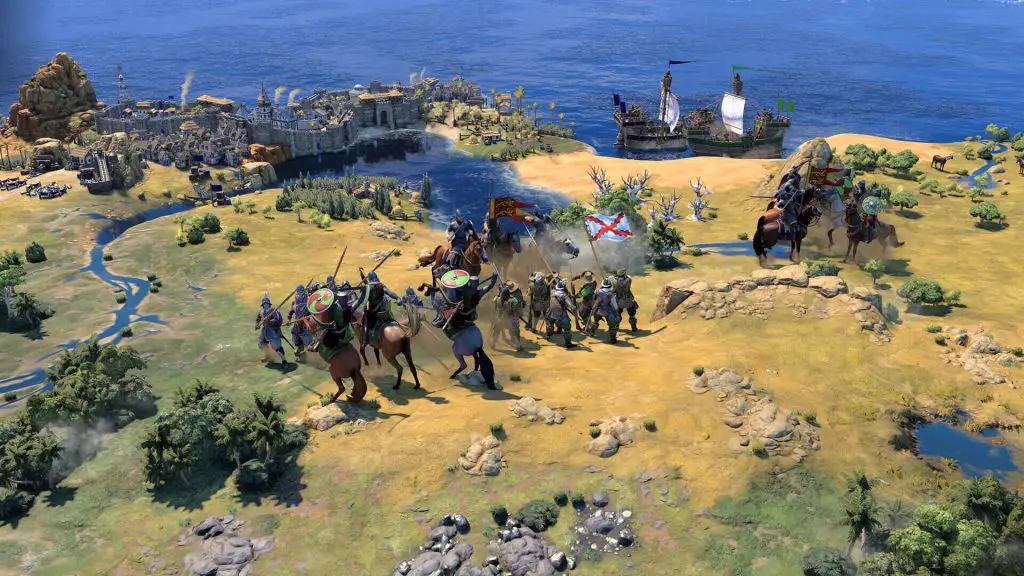
Nuclear strategy expands with additional offensive and defensive options and a revised approach to mutually assured destruction.
Firaxis is also introducing Multilateral Agreements, through which several leaders can respond collectively to developments such as another empire’s growing nuclear arsenal, pursuing disarmament or escalation. City-State proxy conflicts provide another way to exert military pressure without committing to direct war between empires.
City-States also become part of managing an empire’s territory. Settlements can be granted independence, allowing their former owner to reduce pressure on the Settlement Limit while opening opportunities to engage with enhanced City-State abilities. Campaigns can progress into the Atomic Age from Antiquity, or begin there through an Advanced Start.
The update introduces two other systems with economic and cultural applications. Manufactured Goods uses recipes to process combinations of commodities into resources such as Enriched Uranium. Great Works of Film sends Film Crews searching for locations suited to particular genres, with the resulting benefits depending on the quality of the finished production.
Earthrise Connects Space Exploration With Environmental Management
Earthrise builds its space program across the campaign, beginning long before rockets become available. During the Antiquity and Exploration Ages, civilizations chart the night sky and name celestial bodies.
The Modern Age introduces early orbital missions around Earth and the Moon, before the Atomic Age allows an established space agency to dispatch missions throughout the solar system. Discoveries and resources found through those missions contribute to the civilization back on Earth.
Firaxis also confirms a new Science victory, while noting that the benefits of engaging with space-related systems will support more than that single victory route. That makes the expansion’s astronomy and spaceflight progression relevant beyond a dedicated scientific campaign.
Environmental adaptation forms the expansion’s other major component. Technologies and unit abilities can change terrain and tile bonuses, while civil engineering structures help counter natural disasters that become more frequent as global temperatures rise.
Civilizations develop additional advantages in particular biomes as they become more proficient at working those environments, connecting environmental specialization with territorial development.
September’s Update 1.5.0 Adds True Start Location Earth Maps
The next patch brings a True Start Location Earth map, placing civilizations in locations representative of their historical origins. Natural Wonders retain their real-world locations, but the selection appearing in each campaign changes.
Terra Incognita and Shuffle maps are also moving to Firaxis’s Voronoi generation algorithm, alongside improvements intended to accelerate map loading and generation and produce more varied resource placement.
Diplomacy gets a practical adjustment: spending Influence can preserve an alliance without requiring participation in an ally’s war. Interface work includes revised plot tooltips, settlement banners, and game setup, plus a tile ruler for planning settlement layouts.
Firaxis plans to begin Arc of Tomorrow playtesting later in 2026 through the Firaxis Feature Workshop. Both major releases remain in development, with their details subject to change. The studio also expects a lighter update cadence after version 1.5.0 as development shifts toward the larger additions planned for 2027.