

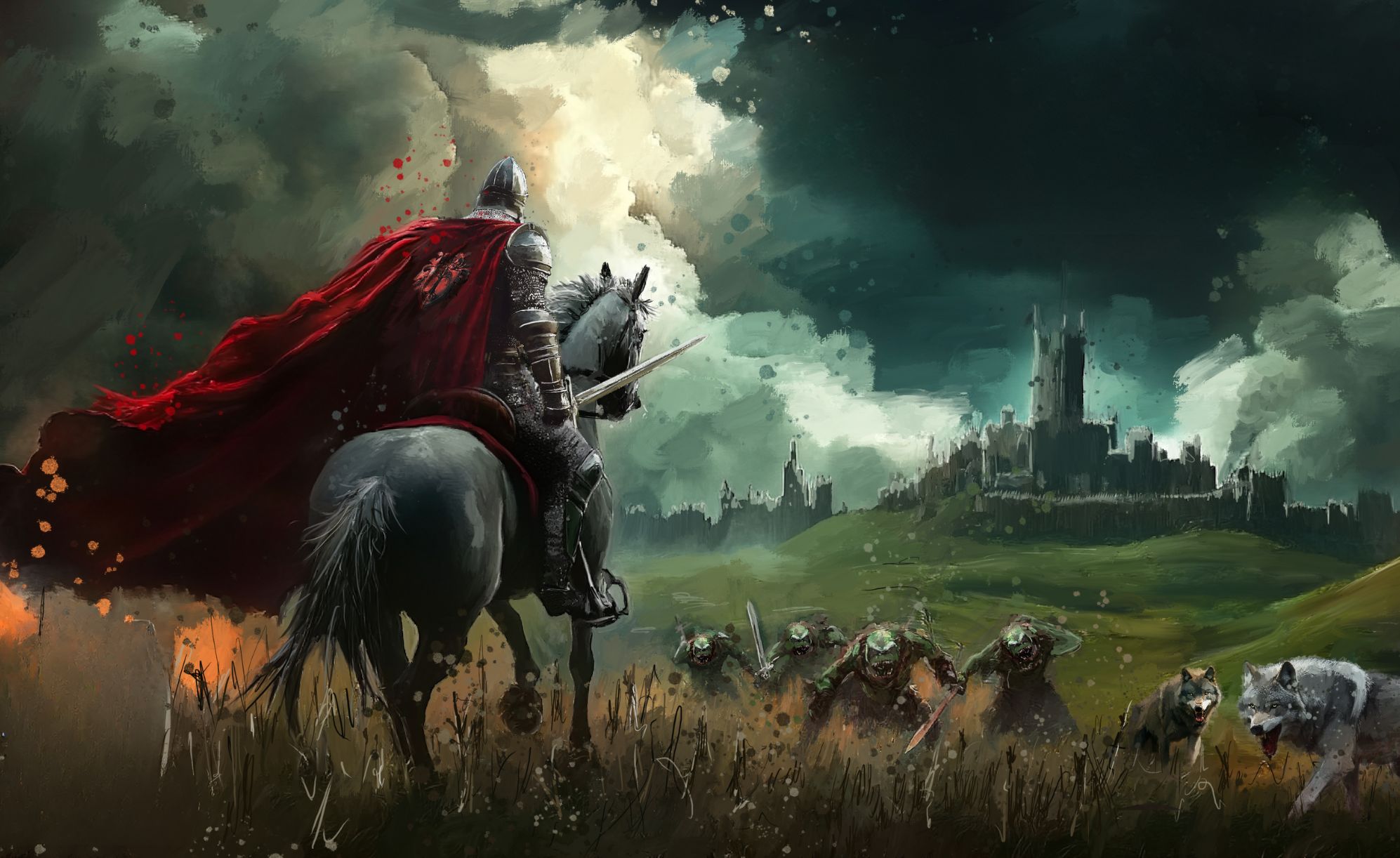
A solo-developer RPG where the main goal is to survive as long as possible.
I just devoured the latest devlog for Knights of Frontier Valley, an RPG I’ve been following for ages, and yes, I even wrote about it back in 2022. In March 2025, the legendary publisher MicroProse stepped in to back the project.
Today, I’m bringing you fresh details on solo development by Adamant Studios (Martin Menzel), and honestly, my hype for this title has only skyrocketed.
However, before diving into the details of the latest devlog, let’s introduce the game Menzel is working on, which is one of the most intriguing and promising RPGs on the horizon.

Knights of Frontier Valley drops players into a procedurally generated realm where no two journeys unfold the same way. Each run begins with a fresh world map, reshuffled dungeons, and shifting faction politics, while a fully simulated day-night cycle and four-season calendar make the landscape feel alive.
Whether you’re trudging through a winter blizzard or chasing fireflies on a balmy summer night, the game’s custom engine recalculates lighting, weather, and travel times on the fly, so that sunrise over a distant mountain range happens at the precise minute the in-game Time Manager predicts.
Survival is at the heart of every decision. Hunger, thirst, exhaustion, sickness, and even clothing appropriate to the season can mean the difference between life and an unceremonious grave.

Encounters play out in gridless, turn-based tactical battles that let you position attacks with pixel-level precision. Choices carry weight: skills picked at level-up are permanent, wounds take days to heal, and your deeds ripple through the Valley’s social fabric, altering how factions trade, feud, and wage war.
Behind the curtain, hundreds of persistent NPCs pursue individual schedules, working, sleeping, traveling, and gossiping, regardless of whether the player is watching.
Each character runs on an action-queue AI that can improvise if a door is locked, a storm rolls in, or the player suddenly starts a bar-room brawl. Thanks to off-map routing and a lean memory manager, the simulation never stalls: villagers relocate across provinces in real time even when their maps aren’t loaded, and the GPU-friendly 2.5-D renderer keeps frame rates smooth on modest hardware.

Hand-drawn art, zero generative AI, and design guidance from D&D legend Rob Kuntz round out a package that blends classic RPG nostalgia with modern systemic depth.
In his post, which can only be watched as a video, tellingly titled Behind the Code: How One Developer Is Building a Living, Breathing RPG Engine from Scratch, he invites readers into the guts of a custom engine he coded entirely on his own.
The diary opens with a guided tour of the Valley at dusk: the sun sinking behind the hills on a timetable calculated by a Time Manager, trees bending to gusts orchestrated by a Weather Manager, and snow swirling in front of the camera thanks to a particle system embedded in the map renderer.
Even the route your hero takes across the countryside is chosen by a Pathfinder that threads automatically around obstacles while the rest of the engine adapts the simulation speed to keep everything smooth.

Menzel emphasises that none of this would have been feasible if he were locked into somebody else’s middleware; he needed code he understood down to the byte so he could marry low-level memory management with high-level simulation in one coherent design.
He admits the decision cost him roughly five years of part-time work, months spent scrapping a first prototype, moving to the open-source libGDX framework for raw OpenGL access, and writing every core subsystem himself: the 60-frames-per-second main loop, the renderers, the persistence layer, the state machine, networking hooks, a sound pipeline, and a surprisingly frugal memory manager that lets my aging laptop run the game without spinning its fans.
All of it is wired together by modules that drop in and out as needed, so the graphics card can take a vacation, as he puts it, while the CPU pulls the strings behind the curtain.
The heart of his simulation is the character model. Instead of tracking every citizen individually, the game bundles them into dynamic groups that share leaders, formations, and even collective death logic.

Each character owns an action queue: one moment, that queue might read walk, turn, greet, the next it might be purged and rebuilt because the player picked a fight or a door turned out to be locked.
Those queues persist through saves, meaning hundreds of NPCs go right back to their chores the instant you reload.
Travel is its own rabbit hole: when an NPC decides to march from an attic in one city to a cellar in another, the engine builds only the next leg of the journey, pauses at each waypoint to see if circumstances have changed, and uses a clever off-map-routing shortcut to estimate progress on maps that aren’t even loaded.
The result is a world that keeps moving long after it scrolls off your screen, yet never wastes cycles simulating miles of terrain you might never visit.
Menzel’s résumé, GPS software, first-generation iPhone hardware, and Tesla autopilot components explain the origins of the engineering discipline. Still, the devlog also reveals the romantic streak that drives him through the tedium of writing data structures that most players will never notice.

He still calls the project fun, most of the time, though he warns that anyone tempted to follow his path needs a Jedi-level commitment; otherwise, the years of unpaid evenings and weekends will grind you down.
What makes the story richer is the company he now keeps. Legendary D&D designer Rob Kuntz is guiding the systemic design, and veteran publisher MicroProse is giving the project a home alongside its stable of simulation classics.
Yet the soul of Knights of Frontier Valley remains one developer hunched over a code editor, fine-tuning how long a snowflake drifts before it melts on a pixel of farmland.
Reading the post left me with that old CRPG thrill, the sense that somewhere beyond the edge of the monitor lives an ecosystem that doesn’t need me to keep time. When I finally step into the Valley, I’ll do so knowing that every sunset, every gust of wind, and every villager’s lonely trek across the world is unfolding on rules hand-written line by line by a single mind.
Knights of Frontier Valley doesn’t have a release date yet, but you can bet I’ll be keeping a close eye on the development of this deep RPG and share any relevant news about it. In the meantime, you can wishlist the game on Steam (where you can also read the full devlog) and check out the latest trailer below.

