

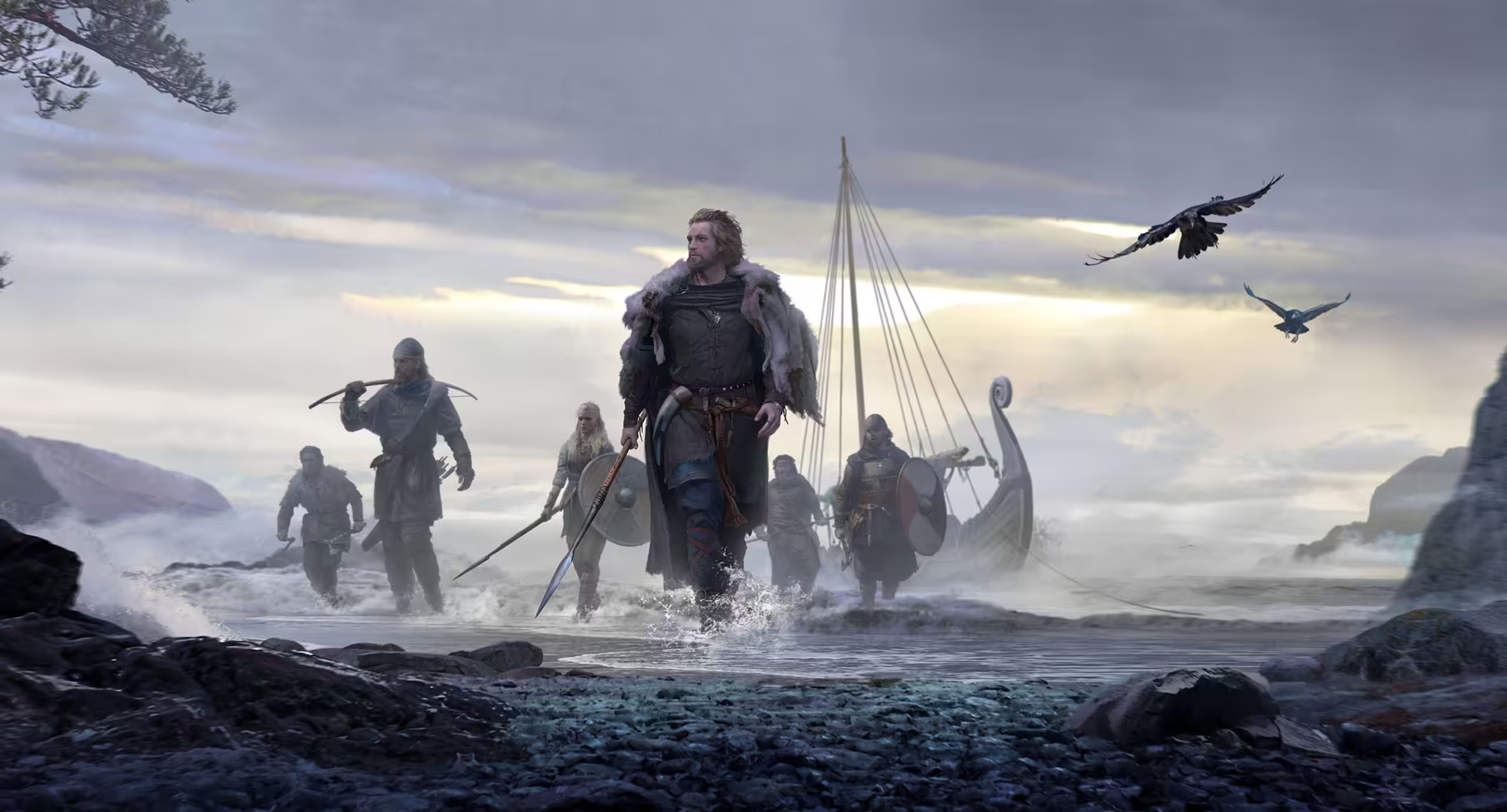
Tripwire Presents and Arctic Hazard are lining up NORSE: Oath of Blood as a very specific kind of Viking fantasy: less god powers from the sky, more mud, blood, and arguments around the longhouse table.
In the past few days, the official release date dropped for this intriguing strategy RPG, which has already won players over with a demo that’s racked up a “Very Positive” rating. So I decided to pull together some info to give you a clear idea of what to expect from the final game.
We are talking about a turn-based tactics game about leading a warband. In practice, it’s closer to an XCOM-style campaign where you also run the village your warriors go home to, manage the people who forge their axes, and live with the consequences when someone doesn’t come back from a raid.
Below is a breakdown of how the main systems fit together, based on the official material, the Unreal Engine developer interview, and hands-on previews of the current demo.
Story and Setting: A Grounded Viking Revenge Saga
You play as Gunnar, a young warrior driven into exile after rival chieftain Steinarr Far-Spear murders his father, Jarl Gripr, and seizes power. With his home burned and his people scattered, Gunnar has to carve out a new settlement, build alliances, and gather enough strength to challenge the usurper.

The story is set in 9th-century Norway, at the dawn of the Viking Age, and it leans heavily on historical fiction. Arctic Hazard brought in bestselling author Giles Kristian (Raven saga, The Rise of Sigurd) to write the narrative, and it shows in the way they talk about the game: the saga is character-driven, with a revenge plot that branches through relationships, oaths, and old grudges.
There’s already a free prequel short story, Sword Brothers, available as ebook and audiobook, which covers a raid deep in the Norwegian fjords and sets up some of the personalities you’ll meet in the game.
During the campaign, your choices around diplomacy, allies, and internal village politics are billed as key levers that can shape how Gunnar’s rise plays out and whether he restores his father’s legacy or leads his people into disaster.
Turn-Based Combat on a Tight Grid
NORSE: Oath of Blood uses party-based, turn-based combat on a grid, with a camera angle that sits somewhere between Baldur’s Gate 3 and classic XCOM. You control a small warband of named characters, each with their own toolkit, and fights reward good positioning, smart sequencing, and use of the environment.
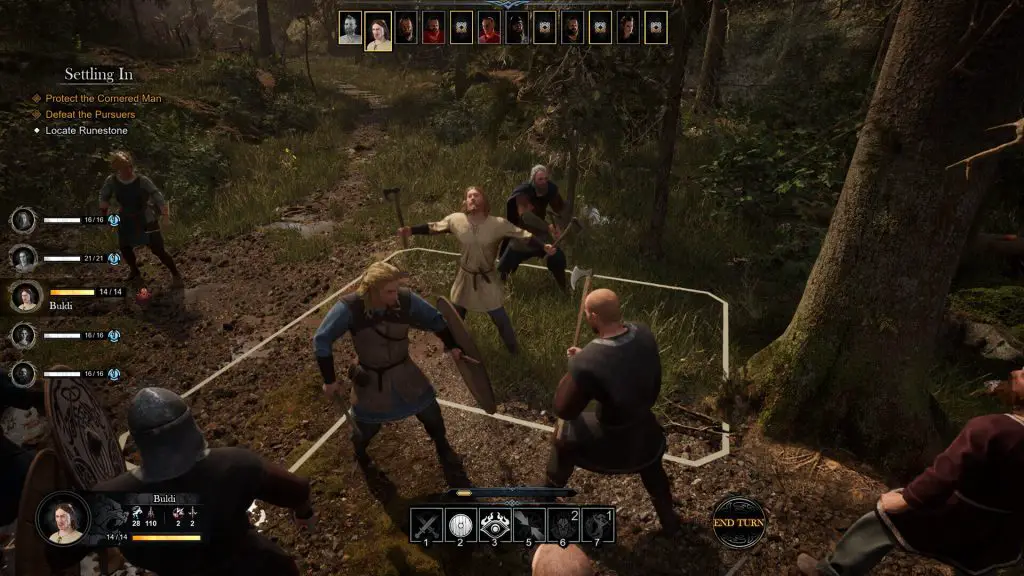
- Positioning and terrain – Elevation affects combat, flanking matters, and the battlefield includes hazards you can use to your advantage. Fighting in muddy fields, rocky clearings, or snow-choked villages isn’t just cosmetic; it’s part of your toolkit.
- Synergy between abilities – Each warrior brings a distinct skill set, and many abilities interact with one another. Gunnar, for example, uses a wrestling-style move to hoist an enemy and throw them behind him, setting them up for finishers from the rest of the team.
- Risk-reward play – The game encourages aggressive maneuvers that expose you for a turn in exchange for big tempo swings, especially when you start to factor in its injury and death systems (more on that next).
Exploration and combat share the same 3D spaces. In the demo, you can move through the world with either click-to-move controls or direct WASD input, then slide seamlessly into turn-based battles when steel is drawn.
At the Gates of Valhalla: Injuries, Death, and Glima
One of NORSE’s most distinctive systems sits on top of this combat: the way characters get maimed, cling to life, and sometimes die for good.
Most of your warband (the non-hero characters) can die permanently. But when a unit’s health hits zero, they don’t automatically vanish. They enter a special state where they keep fighting on borrowed time. Every further hit they take in this state increases the chance of outright death.
If they survive the mission, they don’t walk away unscathed. Instead, they pick up injuries, which range from simple debuffs (reduced effectiveness in battle) to serious wounds that bench them for a stretch and sometimes leave permanent disfigurements that become new traits.
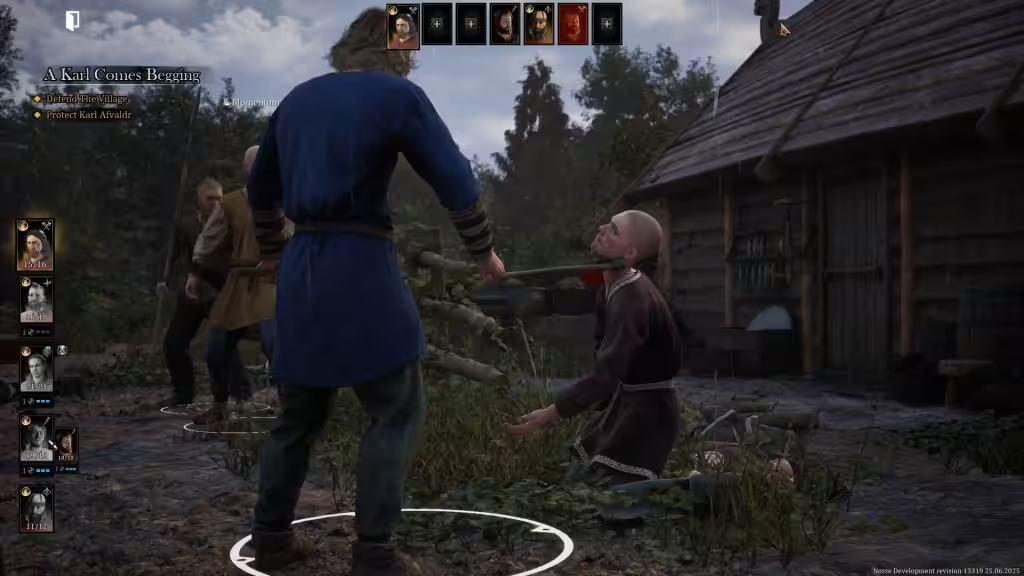
The design aim is to give you some leeway when things go wrong, without softening the sense that losses matter.
Hero characters, the people the story can’t continue without, can also enter this limbo. If one of them actually dies, the mission fails, and you’re forced to replay it. That keeps the overarching narrative intact while still letting you push your luck in individual encounters.
On top of that, the team has woven in Glima, a traditional Nordic wrestling style. In gameplay terms, Glima is a set of special abilities focused on grapples, throws, and positional manipulation.
Glima appears as close-quarters grapples and throws that let you control enemy positioning and create openings in the line
Together, the injury system and Glima add a strong push-your-luck flavor to what could otherwise be a fairly standard tactics loop. You can let someone fight on when they’re hanging by a thread; you just have to live with the scars, or a funeral pyre afterwards.
Warband Management and Characterization
Outside individual fights, you’re managing a roster rather than a faceless pool of units. NORSE splits your people into two broad groups:
- Warriors: the fighters you bring into battle.
- Villagers and specialists: crafters, farmers, and other workers who keep the settlement alive.

On the combat side, you recruit and train a variety of fighters, each with a unique skill set. Gear is customizable, and abilities are upgradeable, so over time your warband develops into a mix of bruisers, archers, support characters, and more exotic roles shaped by the Glima and injury systems.
Narratively, Arctic Hazard and Giles Kristian put a lot of emphasis on making these people feel like individuals.
The Unreal Engine interview talks about warriors and tradespeople having detailed backstories and strong personalities, which inform both their dialogue and their visual design. The idea is that you’re not just losing “a level 6 shieldbearer” when someone dies; you’re losing Torsten’s favorite drinking partner or the only villager who never complained about night watch.
Demo Early conversations mix coarse humor and everyday bickering, with sharper, more serious moments when raids go wrong or the cost of Gunnar’s choices catches up with him.
Settlement Building: From Farmhouse to Stronghold
The other half of NORSE: Oath of Blood plays out back at home. Your settlement is both a strategic layer and a narrative hub.

From a cold systems point of view:
- You start with a small camp and grow it into a fortified village.
- You assign villagers to roles, manage resources, and upgrade buildings.
- Core structures include a smithy, armory, and workshops, which unlock better weapons, armor, and equipment for your warband.
- You scavenge the wilderness, trade with allies, and manage supply lines so you don’t send people into battle under-equipped.
The interesting twist is that all of this is wrapped in character interactions. The settlement acts as a hub where you talk with workers like Torsten the blacksmith while queuing up new gear.
Those conversations aren’t just flavor; they reflect your progress, the outcome of recent raids, and even the mood of the people. NPCs might gripe about overwork, mourn fallen warriors, or occasionally be too drunk or otherwise “indisposed” to help you.
The team also mentions seasonal ceremonies, internal disputes, and settlement-wide decrees that affect various aspects of the game. Those decisions sound like the strategy layer’s equivalent of tactical risk-reward: Do you push the village toward harsher laws for short-term gains, or keep people on your side and accept a slower build-up?
You’re walking through a place that changes as the campaign advances, with people who remember what you did last season.
Exploration, Missions, and Campaign Flow
The current Steam demo offers an early slice of the campaign. It opens with Gunnar and his small band of mercenaries arriving in new lands, negotiating with a local community, and agreeing to clear out bandits who’ve been terrorizing the area. If you succeed, the villagers will help you establish your new home.

Structurally, that first chapter shows how the game wants to flow:
- Overworld exploration: Move your party across a detailed 3D map, talk to NPCs, pick up tasks, and trigger set-piece encounters.
- Tactical engagements: When trouble starts, the camera drops into grid combat, where you juggle action points, positioning, and ability synergies to win.
- Return to settlement: After missions, you go back to camp to heal, craft, upgrade, and deal with the political and social fall-out.
Over the longer term, Tripwire and Arctic Hazard describe the campaign as a story-driven strategy game where your relationships and decisions around rival clans, allies, and internal conflicts influence both the narrative and the development of the village.
It’s less of a free-roaming sandbox and more of a directed saga with meaningful branches.
Historical Authenticity, Visuals, and Sound
One of NORSE’s big selling points is how grounded it wants its world to feel. Arctic Hazard is a Norwegian studio, and the team has spent a lot of time visiting museums, reconstructed Viking villages, and archaeological sites to nail the look of houses, clothing, weapons, and landscapes.
The game is built in Unreal Engine 5 and makes heavy use of Nanite, Lumen, Quixel Megascans, and MetaHuman to push a realistic, almost documentary style of Viking-Age Norway: longhouses blackened by smoke, wet fields, rough timber walls, and faces that look like actual people rather than caricatures.
On the audio side, the latest feature list highlights an original score by composer Dan Wakefield and dark pagan neo-folk band Galdorcræft, which should give the game a very specific sonic identity, closer to ritual drums and chants than Hollywood orchestral bombast.
The result is a tactical RPG that leans into “Vikings as they might have been”, still myth-tinged and dramatic, but rooted in cold weather, hard work, and ugly violence.
Platforms, Demo, and What to Expect at Launch
We’re not far from the game’s full release, and below you’ll find all the essential information.
- Release date: February 3, 2026.
- Platforms: PC via Steam, Epic Games Store, and GOG; PlayStation 5; Xbox Series X|S.
- Demo: Available on Steam right now. It covers an early narrative chapter and mission, including combat and an introduction to village management. The demo currently holds a Very Positive rating (around 89% positive across 200+ reviews).
- Modes and languages: Single-player, with full audio and subtitles in English plus several major European and Asian languages.
If you enjoy tightly paced tactics with meaningful attrition, like XCOM, but also want the slower satisfaction of watching a village grow and seeing the same faces around the fire between missions, NORSE: Oath of Blood looks like it’s aiming squarely at that niche.
The demo already shows how those parts connect; the full game will decide whether Gunnar’s saga earns a place alongside the other long-running campaigns in your library. Below is the latest story developer diary trailer.


