


Announced during the PC Gaming Show, Neath is the kind of project that makes sense for Cellar Door Games and still feels like a sharp left turn. After Rogue Legacy and Full Metal Furies, the studio is now working on a grim, eldritch roguelite tactical RPG where players not only move their own units on a grid, but also dictate what enemies do on their turns.

The game is set in a decaying world overshadowed by an irradiated, inverted tower that reaches down into the earth rather than up into the sky.
That tower is ruled by a god whose ever-shifting edicts, called Taboos, constantly rewrite the rules that govern each run. One expedition might punish direct attacks on certain enemy types, another might warp movement or healing.
The Taboos act as a persistent pressure on the player, asking them to adjust tactics on the fly while they lead a band of fragile warriors floor by floor through this corrupted citadel.
At the heart of Neath is its fluid turn-based system. Battles play out on a grid in a top-down 2D pixel-art view, but the classic initiative bar is in motion: turn order is always shifting, and the player can directly influence it.

When an enemy targets one of your units, that character becomes locked in engagement, frozen in fear, and unable to act until the threat is resolved. The only way out is to disrupt the attacker.
You can knock enemies away to break their focus, shove allies clear of danger, or even redirect the blow to someone more expendable. The design pushes the player to think about positioning and tempo which gives the whole thing a strong Into the Breach flavor with a horror twist.
Because you can also control enemy actions, turns become a resource in themselves. The same system that lets you save a terrified ally can be used to force a monster into a bad trade, walk a cultist straight into a poison cloud, or trigger a chain of knockbacks that hurls a target across the room.
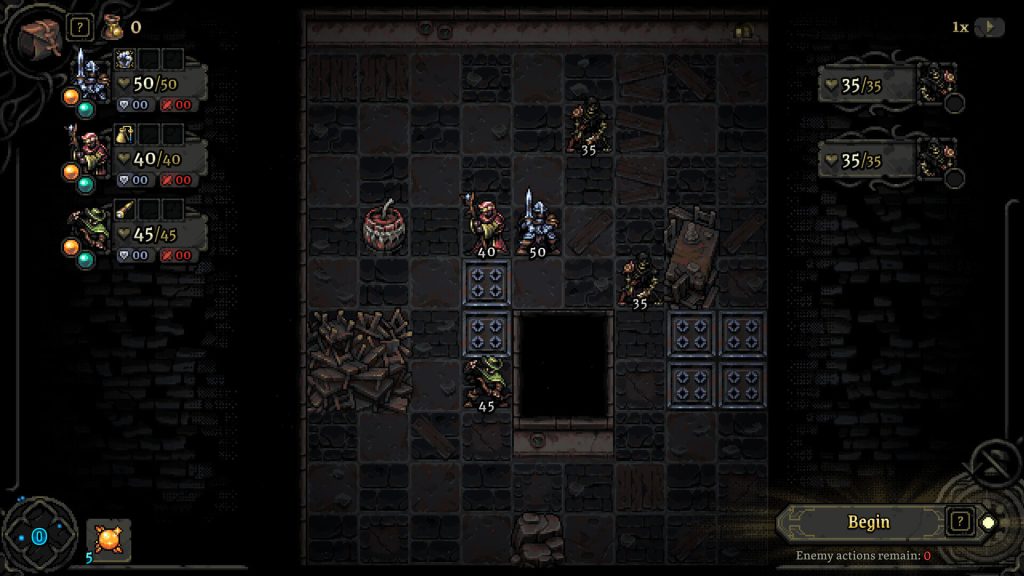
The developers talk about controlling every moment, and that fits: each decision is about sculpting the entire board state rather than just choosing an attack from a menu.
Exploration between battles leans into 1990s dungeon-crawler sensibilities. Encounters and events are presented in a style reminiscent of classic grid-based RPGs, complete with text-driven choices that reshape the party over the course of a run.
These sequences are where the wider systems of Neath come into play. Fate’s Die, a key item lets players meddle with outcomes: you can fizzle trapped chests to avoid disaster, bargain with the gods for boons, or push your luck and risk brutal consequences.
The tone stays firmly in eldritch territory, with grotesque monsters, blood, and a narrative that leans into fear and dark mystery.
As with any roguelite, long-term progression is just as important as surviving a single expedition. During runs, you recruit and build up your warriors, unlocking new abilities and hunting down relics that encourage unusual synergies.

Some builds let you poison the air itself so enemies suffocate as they advance, others focus on heavy knockback and battlefield control. Because the Taboos and events shift from climb to climb, the same build will not always behave in the same way.
Outside the tower, the town of Shale acts as a settlement layer. Here, players invest in infrastructure and assign their serfs to different roles, effectively tuning their starting conditions before each run.
Focusing on certain upgrades might lean your party toward tankier frontline fighters, faster skill progression, or a better supply of relics and consumables. It is the familiar roguelite loop, fail, improve base, try again, but framed through the lens of a crumbling, god-haunted society.
Visually, Neath goes for moody pixel art away from the cartoony look of Rogue Legacy. Screens show cramped, oppressive arenas lit by sickly glows and crowded with warped, insect-like creatures.
Neath is confirmed for a 2026 launch on PC via Steam. There are no details yet on other platforms or more precise dates. In the meantime, below is the trailer.


