

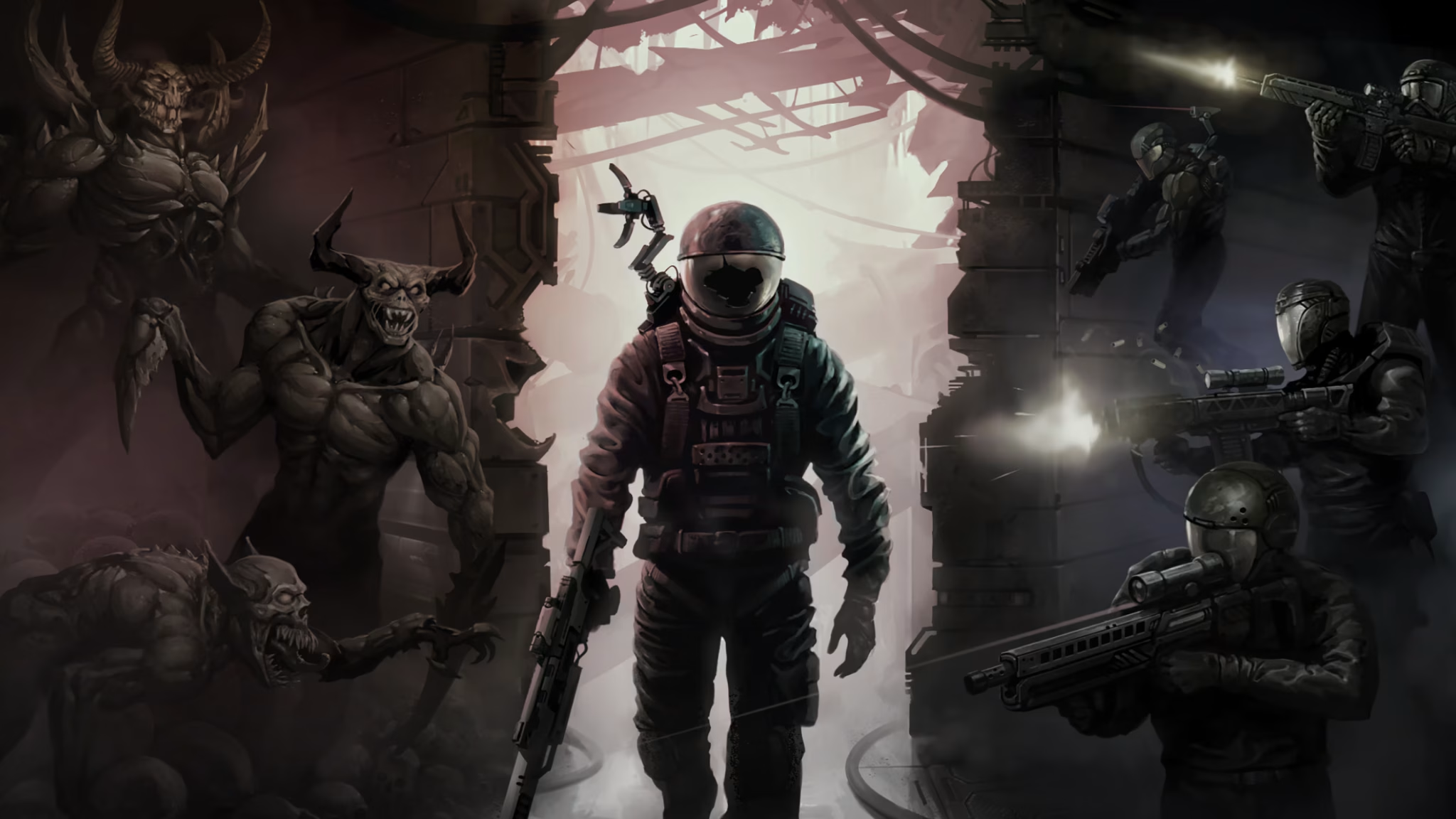
In the dying embers of 2022, Quasimorph commenced its lengthy development journey, from which it has re-emerged four years later. Now it’s time to check if version 1.0 survived or succumbed to the machinations of Steam Early Access.
So grab a weapon. Don your armor. Slide that combat knife down the inside of your boot; it’s time to lock-n-load.
CONTENT
Quasimorph possesses many of the trappings that make Sword of the Stars: The Pit (TP) such a stellar game. It tweaks its successful formula by exchanging marathon survival runs for a lean but stimulating strategy layer that anchors a multitude of shorter, objective-led missions.

Strategy occurs upon a persistent map of the solar system, with the player plotting trips on their ship – a home-base, from planets to moons to space stations.
This is where potential missions, goods trading, ship development, and mission prep are conducted. Fostering faction relations is a by-product of retaining access to the goods and equipment they supply.
Linked procedurally generated maps of mixed sizes and layouts provide the platform for turn-based missions. Each has its own goal to achieve from a small number of varied types. Filled with a mix of activities that include: loot to scavenge, enemies to defeat, workstations that allow crafting, repair, or recovery, and sometimes the possibility to interact with security apparatus.

Turn-based combat is blessed with a plethora of tactical options from character perks and a pool of varied inventory that consists of firearms of different calibers, with different ammo types.
Alongside melee weapons, explosives, automated turrets, and even artificial allies. Mostly humanoid enemies are joined by a few choice exotic types such as robots or guard dogs. Then come the quasimorphs, demonic-like spawns that emerge from within dying humans depending on an incremental counter.
Character development is a mix of gaining XP or perks rising organically through use. These affect a small cadre of skills that depend on the class.

Implants artificially augment capabilities. Ship development comes in the form of an orthodox upgrade tree, with strategic and tactical enhancements activated by combining requisite components found or bartered for.
ATMOSPHERE
Quasimorph’s audiovisuals are on a par with TP, with a similar look and feel and yet subtle differences. Replacing the bright, light-hearted aesthetic of TP’s cartoony graphics with those of a more mature nature. This perfectly suits the game’s alternate sci-fi theme of a futuristic corporate war-dominated setting.
Ambiance varies depending on the biome and soundtrack used for the mission. Most have a darker, somber vibe. Some come with a colder, sterile feel. Others are warmer, more inviting. A few soundtracks on rotation do their best to add to the mood. Some succeed. Others not so much.

Level design imprints its own touch on the mood. Uncertainty is a constant companion due to the fog of war. Twinned with an extra helping of claustrophobia from traversing the maze of corridors and tunnels. Larger, more open levels come with a feeling of isolation due to a lack of living entities, organic or otherwise.
GAMEPLAY
A familiar game-loop for turn-based games provides a smooth flow for activities that revolve around preparing & undertaking tactical missions.
These play very much like TP, with limited step-based increments followed by those of the enemy. This demands a slow, methodical approach that sets the tone for the entire experience.
Since mission objectives are short on variety, they can feel somewhat repetitive. Only escorting VIPs or defending locations stand out from the standard elimination types. Contending with waves of spawns alters this. While some missions have time limits, the hunger mechanic acts as a constant informal kick up the backside, as food is finite.

A lack of dynamic elements necessary to alter the flow of a mission sometimes gives the experience an on-rails quality.
Only affected when new enemy mobs spawn, or previously alive NPC allies are found dead when revisiting rooms. At the strategy level, the potential of missions changing during ship transit from one system to another is annoying.
Pitfalls that will likely end a run prematurely are pretty much genre standard. Forgetting to take vital items can be painful as there is no deliberate check before embarking on a mission. Opting for missions beyond operator capabilities is another sure way to be defeated. Knowing when to prioritize healing, fight, or flee during an engagement matters.
The complexity of mechanics gives combat a lot of options and makes it very satisfying when tactics work out. The extensive range of firearms and melee weapons provides a delicious variety of means to take down enemies.

There are plenty of armor types too, each with a myriad of different resistances. Knowing which to wear against a particular enemy can be the key to completing a mission. States from weapons and environmental factors contribute to different injuries or paralysis that require appropriate meds to recover from.
Alternate fire modes can inflict greater damage in one attack. Target penetration means a single shot can hit multiple targets.
While use of cover provides protection from direct shots, breaking line-of-sight ensures operators can’t even be targeted. Various ammo types for each caliber cause different damage types. Useful when dealing with foes that are immune to certain attack types. Explosives are great at targeting multiple mobs or forcing them to retreat.
Turrets and bots are welcome temporary allies when you’re greatly outnumbered or outgunned.

The ridiculous range of loot to scavenge generates a formidable amount of micromanagement in the way it must be individually sorted through.
In addition, a map can have too many empty storage containers, which spoils the fun of finding that ‘special item.’ A strange decision since carry capacity is already heavily restricted. Even with upgrades.
Obtaining unlocks to better faction equipment, increasing the party roster, expanding available classes to imprint new clones with, or to upgrade the ship is purposeful and feels worthwhile. Faction trading and barter is simple enough, but can be initially a little unintuitive.
CHALLENGE
As proudly reiterated by the developers, ‘the game is unfair in a fair sort of way.’ It’s true that with the wrong setup [and tactics], one-hit wipes are only a misstep away. Perhaps the hardest thing is knowing when to take on a harder mission difficulty, as there are no signposts to provide a guide or to know for sure. Leaving the player to their own devices or to try their luck.
When it does happen, dying is actually handled quite fairly. The biggest hit is losing the time and effort invested in the development of the character that died and the inventory being carried at the time.
However, since new operators can be cloned and reprinted on the fly with new classes, this is just a temporary setback.

If the three default settings don’t offer enough control over difficulty, a formidable number of customization options lets players tailor the experience to their preferences.
UI & CONTROLS
The UI is sleek, the definition of efficiency. Easy to read and navigate due to being well laid out. Since information is organized to show a summary at the top level and further detail at the touch of a button, it’s all instantly digestible. Vital when under the pressure of combat.
Highlighting tiles to move to when occupied by bodies is fiddly. Keyboard & mouse seem the preferred option, as controller implementation suffers from a few inconsistencies that affect the efficiency of option navigation and selection.
PRODUCTION
Quasimorph is robustly put together, ready for the brave among us to take for a spin. The game easily demonstrates the almost 4 years of effort that have been injected into it. As expected, a few bugs are still being reported. Though these seem to be mostly minor. Overall, it’s quite polished and is still being supported.

If it needs anything, it needs QoL to flesh out the info screens, additional tooltips, and, in particular, extensions to the tutorial to cover the strategy layer, which is completely missing. Followed closely by tweaks to make controller navigation and selection less of a hassle.
PERFORMANCE
It runs without issue. Even on the older system used for this review. Optimization did not suffer from slowdowns, with the game comfortably running at 60fps or higher throughout. Stability was unimpacted, with no crashes for the duration of several partial playthroughs.
STAYING POWER
Very good replay value comes from the variety embedded in level design, enemies faced & loot to be discovered.
Though a lack of dynamic factors lets this down. The strategy layer benefits from apparent random availability of missions and the pseudo representation of trading and the corporate war conducted by the many factions that inhabit the game.
Longevity ticks many boxes. From the strength of achievements to the ability and desire to replay the game over and over using different strategies or operator classes. Extraneous features such as a game editor & mod support offer the chance to change up the experience.
VERDICT
Quasimorph is sure to suit fans of lone wolf style survival RPGs with a slow, methodical nature and calculating tactical combat.
Especially anyone who enjoyed Sword of the Stars: The Pit, but would love to see it with a DOOMesque skin and a strategy layer to tie all these missions together. You must be comfortable dying over & over and see it as part of the experience.
Despite its few issues, this game is already an unmissable title and, with such staying power, projects excellent value for money. The type of game I won’t uninstall any time soon.
BEST PROS
+ Top-tier turn-based tactical combat
+ Lean, but convincing game world and strategy layer
+ Comprehensive ship development
+ Impressive collection of purposeful inventory and crafting options
WORST CONS
– A lack of accessibility to explain the strategy layer
– Dealing with injuries is punishing and treatment mechanics opaque
– Scavenging for loot is fiddly and requires a lot of micromanagement

