

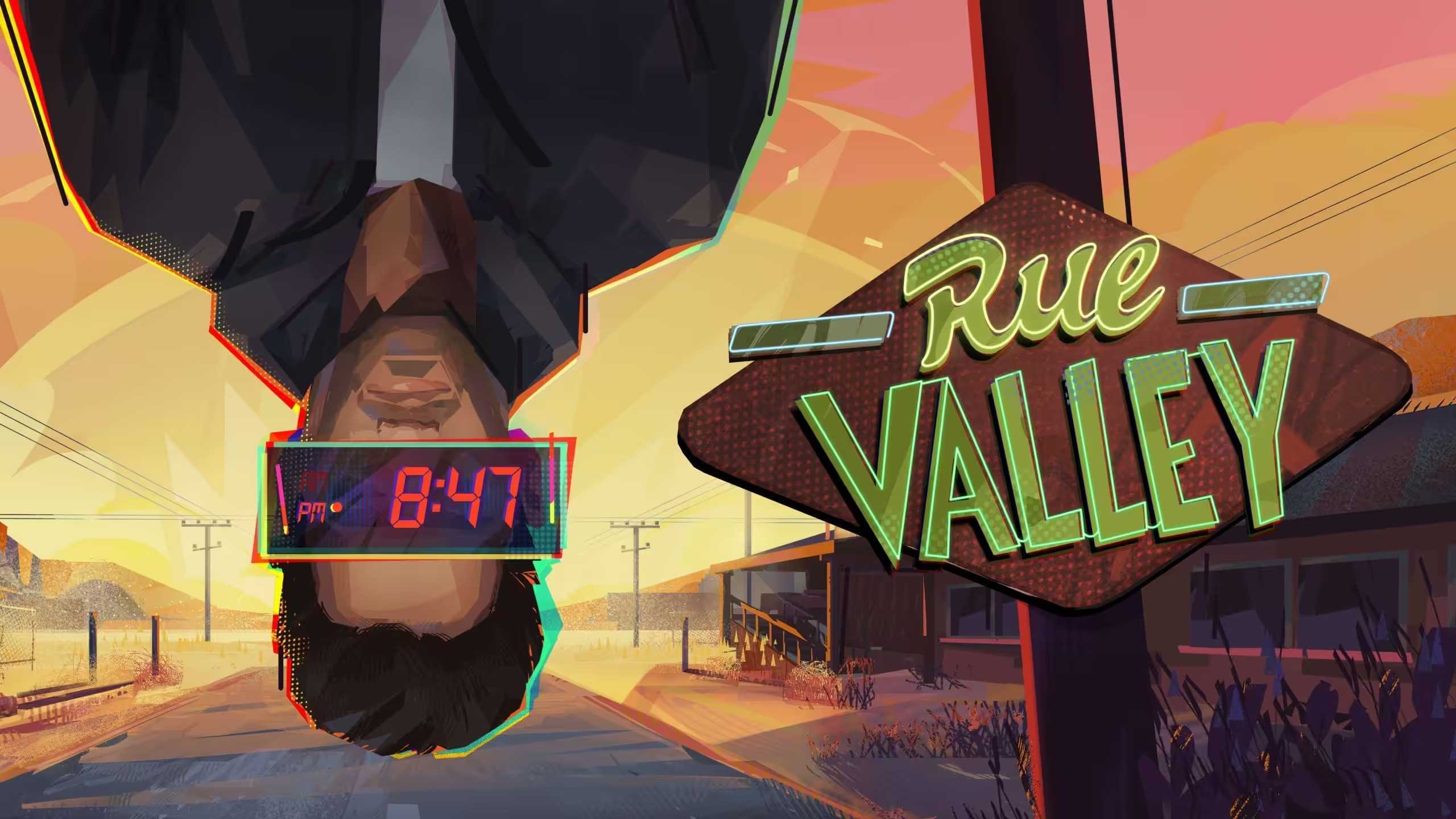
Release Date: 11 Nov, 2025
Developer: Emotion Spark Studio
Publisher: Owlcat Games
Table of Contents
Introduction
Some games test your reflexes. Others test your heart. Rue Valley is one of those rare games that goes deep into the human mind instead of focusing on action or combat.
This semi-isometric RPG tells the story of a man stuck in a strange time loop, forced to attend therapy in an old, broken motel in the middle of nowhere. The people around him are just as lost, each trapped by their own past. As you explore, you uncover the secrets of Rue Valley, learn what causes the loop, and try to break free from it both physically and emotionally.

Inspired by Disco Elysium, the game focuses on deep storytelling, emotional writing, and personal choices. It’s not about fighting enemies; it’s about facing yourself.
Story and Setting
The story begins in a lonely motel surrounded by fog and silence. Time doesn’t move normally here. Each day feels the same, and every conversation seems to circle back to old pain.
The town of Rue Valley has a long history filled with mystery and sadness. The people you meet have their own struggles and secrets. You soon realize the time loop is not just a supernatural event, but a reflection of trauma, guilt, and the inability to move on.
The writing is strong and emotional. It mixes mystery with psychology, and sadness with moments of dark humor. Some conversations make you laugh when you least expect it, while others quietly break your heart.

The story slowly builds tension as you get to know the characters, explore their minds, and start to piece together the truth. It’s more than a mystery; it’s a story about healing, regret, and learning to live again.
Gameplay and Mechanics
Unlike most RPGs, Rue Valley has no combat. You won’t fight monsters or swing swords. Instead, your biggest enemy is your own mind. The gameplay is all about talking, choosing, and reflecting.
At the start, you create your character. But instead of adjusting physical stats or abilities, you shape their personality. You decide who they are as a person, how they think, how they act, and how they feel.
You have three main axes:
- Decisional (Cognitive): Impulsive or Calculated
- Social: Introverted or Extraverted
- Emotional: Sensitive or Indifferent
You get nine points to divide between these traits. You can’t pick both sides of one axis. For example, you can’t be both Impulsive and Calculated. If you go all-in on being Impulsive, you’ll have fewer points left for your Social and Emotional traits.
This system makes character creation meaningful. Every personality setup feels different, and it changes how people react to you.
An Impulsive player might jump into action without thinking, sometimes leading to mistakes or chaos. A calculated player might think too long and miss opportunities. The same goes for the other axes; an Introvert may find it hard to talk to others, while an Extravert may annoy people by talking too much.
There is no perfect way to play. The game doesn’t reward or punish your choices; it adapts to them. Your character’s flaws and strengths both become part of the story.
Traits and Role-Playing
Your personality also gives you Traits, which act as extensions of who you are. For every two points you assign to a specific personality side, you unlock one Trait. For example:
- If you’re Impulsive, you might gain traits like Reckless or Impatient.
- If you’re Introverted, you might gain Secretive or Thoughtful.
These traits influence dialogue. Some lines will appear only if you have the right traits, while others will be hidden. This means your version of the character might say things no other version can.

This system makes Rue Valley feel like a true role-playing game. You can’t act out of character because your personality defines what you can say and do.
Inspiration and Tone
Rue Valley is clearly inspired by Disco Elysium, but it doesn’t copy it; it builds on its ideas. While Disco Elysium focused on politics, addiction, and social decay, Rue Valley focuses on personal trauma, recovery, and the journey toward self-acceptance.
It captures the same emotional depth, the mix of pain, humor, and self-discovery that made Disco Elysium unforgettable. One moment you might cry, the next you’re laughing at something absurd, and then suddenly reflecting on your own life.
The game balances all these emotions beautifully. It feels real, raw, and human, like a therapy session wrapped in a mystery story.
Visuals and Atmosphere
Visually, Rue Valley feels like walking through a dream, or maybe a memory you can’t escape. The semi-isometric view gives you a painterly perspective of the motel and its surroundings.
The world looks tired and old, with peeling paint, flickering lights. The muted colors and soft lighting give the game a constant feeling of sadness, but also a strange sense of comfort.
Every place you visit tells a story, a therapist’s office full of old files, a diner frozen in time, a hallway where the clock never moves. The visual design is subtle but full of emotion.

Character designs are simple but expressive. Even small gestures, like how someone looks away during a conversation, feel meaningful. Rue Valley proves you don’t need flashy graphics to create atmosphere, just the right mood and attention to detail.
Performance and Accessibility
Technically, Rue Valley runs well. The interface is clean, and navigation is simple. Because the gameplay focuses mostly on dialogue, performance issues are rare.
The UI is clear, and the dialogue system is easy to use. The game encourages you not to reload or undo mistakes, your story is your story.
Text is easy to read, and the localization is strong. Even if English isn’t your first language, you’ll easily understand what’s happening. The pacing can be slow at times, especially if you’re used to faster games, but the slower rhythm fits the theme perfectly.
This is not a game to rush through; it’s one to experience.
Sound and Music
The music and sound design play a big part in Rue Valley’s emotional power. The soundtrack uses soft piano notes, slow ambient sounds, and light electronic tones to create a sense of calm and sadness. The music doesn’t force emotion; it lets it grow naturally.
Sometimes, silence speaks the loudest. The quiet hum of the motel lights or the ticking of a clock during a therapy session can make a scene feel more real and intimate.

The sound design reminded me a lot of Disco Elysium’s haunting score by Sea Power, emotional, cinematic, and deeply human. It perfectly fits the tone of Rue Valley: calm, melancholic, and meaningful.
Final Thoughts
Rue Valley is not your typical RPG. It doesn’t give you enemies to defeat or levels to grind. It gives you something far more personal, the chance to look inside yourself.
The writing is beautiful, the choices are meaningful, and the atmosphere is unforgettable. Every decision you make reveals something new about the story, and maybe even about you.
It’s a slow, thoughtful experience filled with emotion, humor, and pain. It’s the kind of game that stays with you long after the credits roll.
If Disco Elysium showed how the world can break you, Rue Valley shows how you can start to heal. It’s powerful, honest, and full of soul.
⭐ 7.5/10 – A moving story about regret, healing, and self-discovery. Rue Valley is a masterpiece of emotional storytelling, not just a game, but an experience.

