
I knew from the get-go that Terra Invicta was going to be a tough egg to crack. A daunting game. The kind of project you don’t approach casually, especially if you’ve already been through the psychological meat grinder that was XCOM: Long War by the boys at Pavonis.
Long War wasn’t just harder XCOM; it was a manifesto. A declaration that complexity, punishment, delayed consequences, and player ignorance were features, not flaws. So, when Pavonis turned their attention from tactical squad combat to the fate of Earth, the solar system, and humanity itself, I knew this wasn’t going to be a friendly strategy game.
This was going to be a commitment. A slow burn. Possibly a lifestyle choice. What I didn’t fully grasp, until dozens of hours in, was just how aggressively Terra Invicta would test that commitment.
Some games aim high. Terra Invicta aims sideways, upward, backward, and directly into the sun, simultaneously. It isn’t just ambitious; it’s borderline unhinged.
This is a game that tries to simulate secret global conspiracies, near-future geopolitics, alien first contact, hard-science space industrialization, and Newtonian fleet combat all inside the same ruleset. Not as separate modes. Not as optional layers. All at once. And somehow, despite regularly feeling like it’s being held together with math, duct tape, and pure spite, it often works.

But “works” doesn’t mean “welcomes you.” Terra Invicta does not ease players in. It shoves them down a flight of stairs, hands them a clipboard, and asks them to save humanity before the aliens notice.
At its core, Terra Invicta is two games fighting for control of the same brain. One is a globe-spanning political thriller where shadowy factions manipulate nations, infiltrate governments, assassinate rivals, and shape humanity’s response to an alien arrival.
The other is a brutally detailed hard-sci-fi simulation of expanding into the solar system, mining asteroids, building stations, designing ships, and fighting space battles governed by real physics rather than cinematic nonsense.
Either of these ideas could have carried an entire strategy game on its own. Terra Invicta insists on doing both. At the same time. With no safety rails.
On Earth, you play as one of seven secret factions, each with wildly different beliefs about what the alien presence means and what should be done about it. Some want to resist, some want to cooperate, some want to exterminate, some want to escape, and some just want to profit.
Each faction has asymmetric goals, different win conditions, and ideological consequences that shape how the world reacts to you.

The Resistance plays the straight man: hold humanity together, prepare Earth, and push back. Humanity First is the same idea filtered through a war-crime blender. The Servants worship the aliens and actively try to usher them in.
Others hedge, flee, manipulate, or exploit. The game doesn’t judge you, except mechanically, where atrocities stack permanent penalties, and reputations matter whether you like it or not.
You don’t directly control nations. You control influence. Through a small council of operatives represented by spies, generals, diplomats, scientists, and criminals, you pull strings. Each counselor has traits, strengths, weaknesses, and personalities that matter. Some excel at espionage but crack under pressure. Others inspire movements but can’t operate in unstable regions. You can’t do everything. You can barely do anything at once.
Every month becomes a triage exercise. Two actions per counselor. That’s it. Do you investigate enemy agents, shore up public opinion, sabotage rival factions, or prepare coups? Every choice means something else doesn’t happen, and Terra Invicta is relentless about consequences arriving late and compounding quietly.

This is where the game is at its best. The politics feel tense, morally messy, and genuinely reactive. Alliances form and dissolve. Nations flip. You might orchestrate an international invasion to stop alien-aligned governments from acquiring nuclear weapons, or broker uneasy coalitions between historical rivals because extinction is a stronger motivator than pride.
You never truly eliminate other factions; you wound them, slow them down, and watch them rebuild. Ideas don’t die easily.
The research system reinforces this beautifully. Public research projects represent humanity’s collective progress, things everyone benefits from, whether you like it or not. Private research tailors those breakthroughs to your faction’s needs. Push public tech too fast, and you might empower your enemies. Ignore it, and you fall behind. Contribute the most, and you steer humanity’s future.
It’s one of the smartest tech systems in strategy gaming, even if the tech tree itself looks like it was organized by someone allergic to folders.
The simulation of Earth is detailed, sometimes eerily so, and tracks global GDP, national economies, inequality, climate pressure, and public opinion. The game starts in a near-future Earth that looks uncomfortably familiar. But this is also where cracks appear.
Nations often feel inert unless a faction pokes them. Entire superpowers can sit on their hands for years while chaos unfolds. Economic catastrophes rarely spill across borders. The model is impressive, but not always convincing.

And then there’s the interface. Terra Invicta’s UI is less a tool and more a stress test. Information exists, but it’s buried, minimized, or whispered when it should be screaming.
Nuclear wars can start with barely a warning. Public opinion swings that will cost you control of a nation hide behind tiny icons. Civil wars erupt with little notice. You learn by losing, and often by realizing you lost ten hours ago.
Early campaigns frequently end in death spirals you don’t recognize until escape is impossible. Earth collapses, space efforts stall, enemies snowball. The game doesn’t explain what went wrong; it expects you to figure it out next time. And yet, there’s a brutal honesty to that design.
Earth has billions of people and abundant resources. The aliens start stronger, but they’re outnumbered. If you can harness humanity properly, you can win. If you can’t, you deserve what happens next.

Then the game pulls the rug out from under you and launches into space. The space layer is a different beast entirely. Expansion into the solar system is detailed to a degree almost no other game attempts. Hundreds of bodies. Resource chains. Construction limits. Boost economics. Delta-V budgets. Shipyards. Supply lines.
It’s intoxicating if you love hard sci-fi, and borderline incomprehensible if you don’t. Building stations and colonies is phenomenal. Deciding where to expand, how fast, and with what infrastructure feels meaningful.
Space eventually becomes self-sustaining, but only if Earth supports it long enough to get there. The transition from planetary politics to orbital industry is one of Terra Invicta’s boldest ideas, and also one of its roughest.

Space combat is where things fall apart. Fights are real-time, physics-driven, and deeply opaque. Most of the battle is decided before shots are fired, by engine choice, thrust, delta-V, armor layout, and weapon selection.
The game does a terrible job explaining any of this. There are no meaningful combat logs. Feedback is vague. One moment, you think you’ve built a flagship; the next, it evaporates instantly, and the game shrugs. Early warships are traps. You don’t know that until you’ve wasted time and resources learning the hard way.
Missiles brute-force solutions work better than they should. Tactical finesse is punished more often than rewarded. Learning requires throwing ships into battles you can’t afford to lose, just to understand why you lost them.
Worse, the Earth layer doesn’t stay politely out of the way. Enemy factions can seize your space assets through political control, undoing massive investments with the same abstract mechanics used on Earth.
Retaking them takes months or years. Marines help, but control can flip back and forth in absurd ways. It makes sense on Earth. In space, it feels nonsensical and infuriating. For a game obsessed with realism, it’s strange how casually it allows speeches to overthrow fortified orbital installations.
And then there’s the aliens themselves, or rather, the lack of them. For a game about alien invasion, they’re oddly abstract for much of the campaign. You hear about attacks. You see purple zones in space. You fight their ships. But actual aliens? Descriptions are scarce. Visuals are minimal. For hours, they might as well be a rumor.
When Terra Invicta is firing on all cylinders, it’s mesmerizing. When its systems clash, it’s exhausting. Politics and space don’t always reinforce each other; sometimes they actively sabotage each other. The learning curve isn’t steep, it’s a cliff face covered in grease.
Terra Invicta doesn’t pretend global politics are clean. It doesn’t pretend space warfare is cinematic. It doesn’t pretend you can master everything at once. It demands patience, failure, and commitment.

And yet, I kept playing. Because beneath the frustration is something rare: a strategy game that actually respects the scale of what it’s simulating.
If you’re willing to suffer for depth, Terra Invicta offers something few games even attempt. Just don’t expect it to hold your hand while the world burns.
From Early Access Chaos to 1.0 Intent
Early Access showed what Terra Invicta wanted to be. Version 1.0 is where it decides whether that vision can finally stand upright without collapsing under its own weight.
Early Access Terra Invicta felt like a brilliant but hostile organism. It didn’t want to teach you. It wanted to observe how long you survived before collapsing under the weight of your own bad assumptions.
Version 1.0 doesn’t suddenly make the game friendly, but it does make it more coherent. Less flailing. More intention. The systems finally start talking to each other instead of screaming across the room.
The biggest shift isn’t content, it’s context. Earth is no longer a vague abstraction stitched together by control points and GDP sliders. With the expanded regional breakdowns and reworked national structures, the planet now behaves less like a board game and more like a fragile, interconnected machine.
Borders matter more. Federations feel earned rather than theoretical. Annexation isn’t just map painting, it’s friction. You can feel the cost of trying to bend the world too hard, too fast. When something goes wrong now, it’s clearer why it went wrong. The simulation is still unforgiving, but it’s no longer opaque for sport.

The alternate start in the future is where Terra Invicta quietly admits something important: not everyone wants to bleed for thirty hours before touching space.
Dropping players into a solar system where humanity already has its boots on metal changes the pacing entirely. Instead of waiting for inevitability, you’re managing momentum. Space isn’t a promise anymore; it’s a responsibility you can screw up immediately.
Combat, meanwhile, finally picks a side. The split between cinematic and realistic modes is less about visuals and more about honesty. Realistic combat strips away the fantasy that space battles are just dogfights with better lighting.
Ships behave like mass, fuel becomes tyranny, and acceleration stops being a toy. You can no longer brute-force your way through ignorance without paying for it. The older model still exists if you want drama, but the new one makes it clear what Terra Invicta has always been about: preparation over heroics.
The space layer also feels less sterile now. New station modules don’t just pad the tech tree; they pull space back into Earth’s problems. Espionage, environment, power generation, space is no longer just industry and murder. That alone helps close the philosophical gap between the two halves of the game.
Events, too, finally start doing what they always should have: forcing trade-offs instead of offering flavor. Demilitarization for economic relief. Officer insights that reshape your faction from the inside. Rare cosmic opportunities that demand attention when you’re already overwhelmed.
These moments don’t interrupt play. Terra Invicta works best when it asks you to choose between two bad options while five other systems quietly degrade.
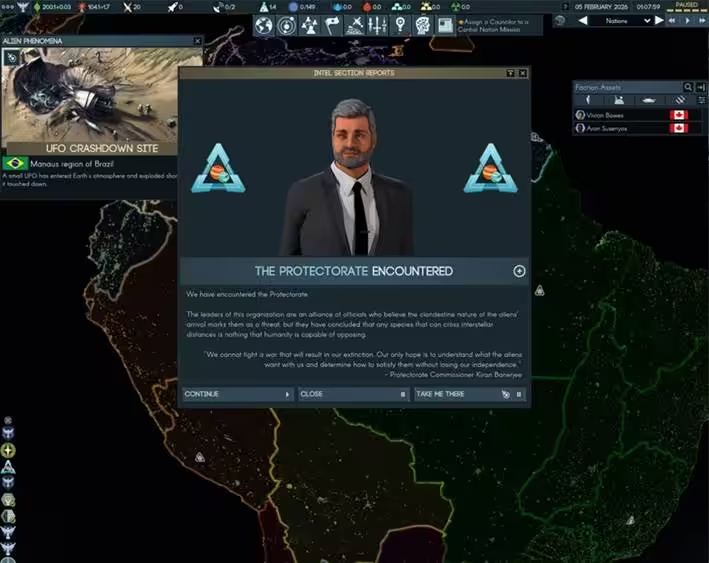
Smarter AI means Earth doesn’t feel like it’s waiting for you to give it permission to act. Space rivals are less passive. Factions feel less like props and more like competing survival strategies.
The interface finally starts acting like it wants you to succeed, not by simplifying systems, but by respecting your time. Managing organizations, tracking priorities, understanding what matters now versus what can wait, that cognitive load has been eased just enough to keep you from drowning.
The tutorial still won’t save you. But at least now it points vaguely toward the exits before the fire starts.
Terra Invicta 1.0 doesn’t tame the beast. It disciplines it. The game is still massive, still demanding, still capable of eating entire weekends without remorse. But now, when it crushes you, it feels deliberate.
Fair. Earned. This isn’t a victory lap release. It’s a declaration. The simulation is done apologizing. If Early Access was Terra Invicta asking, “Can this even work?”, version 1.0 answers with a cold, confident, “Now try to survive it.”
