

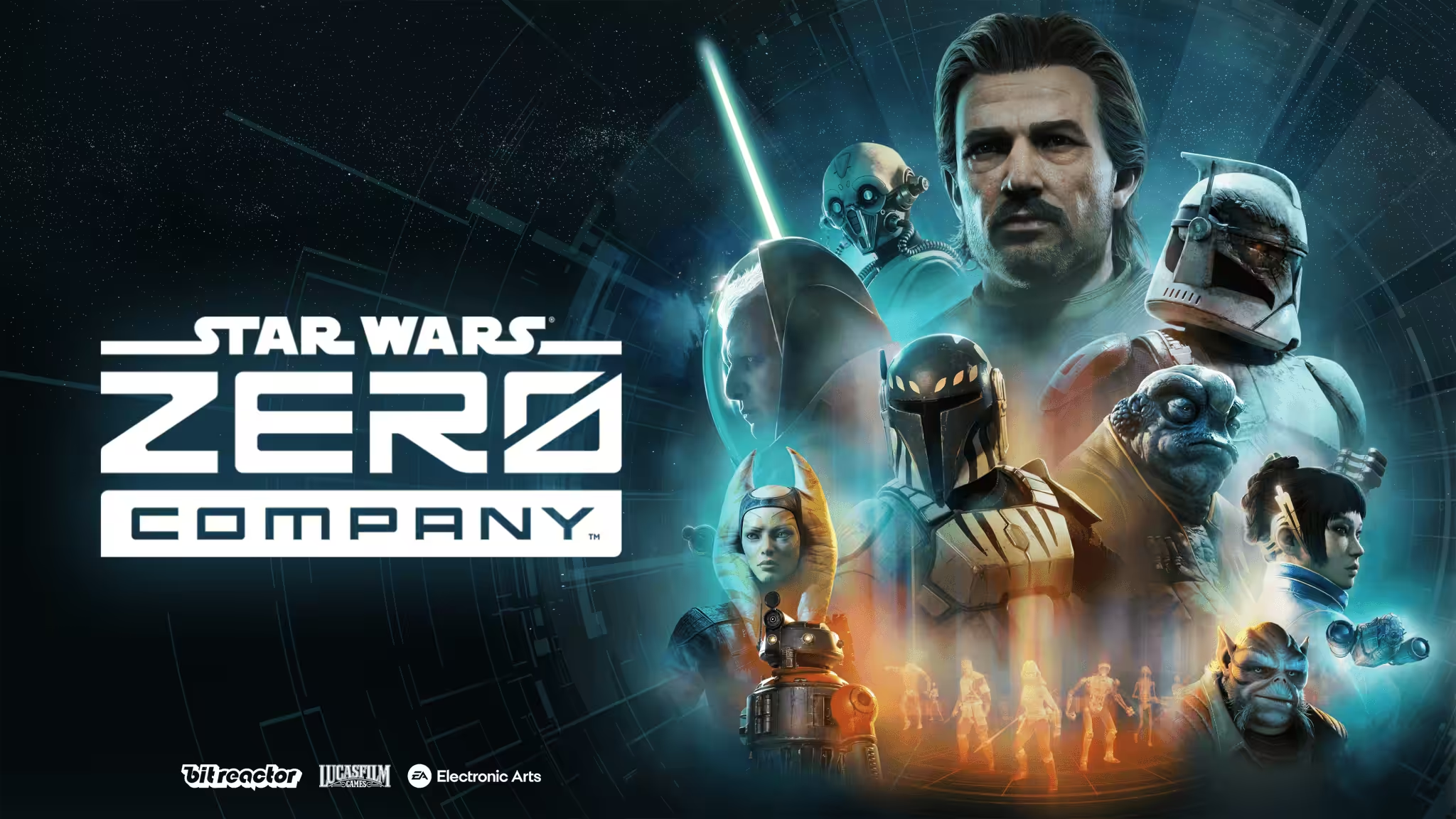
A Star Wars turn-based tactics game is one of those ideas so obvious you assume someone has already made it. Until Star Wars Zero Company, no one had.
It is developed by Bit Reactor, a studio founded by former Firaxis developers, including Creative Director and CEO Greg Foertsch, with a team whose credits run through XCOM: Enemy Unknown, XCOM 2, War of the Chosen, and Marvel’s Midnight Suns. It is made in collaboration with Lucasfilm Games and published by Electronic Arts, and it arrives on 27 August 2026 for PC, PlayStation 5, and Xbox Series X|S.
“Star Wars XCOM” is the shorthand everyone reaches for, and with the community already affectionately dubbing it “ZCOM,” the comparison isn’t wrong.
Bit Reactor is building a hybrid of Mass Effect-style storytelling and third-person exploration, all anchored by XCOM’s grid-and-cover DNA. But the game borrows that foundation specifically to break several of its rules. Here is what’s worth knowing.
Table of Contents
The setup
Zero Company is a single-player, turn-based tactics game set in the twilight of the Clone Wars, telling a gritty, original Star Wars story.
You play Hawks, a former captain in the Grand Army of the Republic who now leads Zero Company, an unconventional outfit of operators for hire recruited for a job that pits them against an emerging threat.

This is not a disciplined military unit, but rather an ensemble of former enemies and outcasts. Alongside Hawks sit authored operators such as Trick, a clone trooper who served with Hawks in the Republic military; Tel-Rea Vokoss, a Tognath Jedi Padawan; Cly Kullervo, a Mandalorian of the ancient Clan Verminoth on a quest for revenge; Luco Bronc, a sharp-tongued Umbaran sniper who fought the Republic’s invasion of his homeworld; Jae Mordant, a dispossessed noble of Shu-Torun set on reclaiming the mining citadel the enemy took from her; and Kabb Uppercut, a Felshi former prizefighter with a cybernetic arm, an original species created for the game.
You can also recruit and fully customize your own operators, down to appearance, clothing, voice, and name.
The squad works out of the Den, a base of operations on the Ring of Kafrene, first seen in Rogue One. The enemy is the Infinite Coil, a Separatist-aligned Dark Side cult. Their goal is the spread of the Shadow Plague, a disease that grants infected members enhanced physical resilience and strange abilities.
How it plays: tactical combat
Tactical missions play out from an isometric view, and combat runs in team turns: your whole squad acts, then the enemy does.
Each operator has three Action Points per turn, spent in any order on movement, attacks, abilities, utility items like grenades and medkits, or Overwatch. There is also Call for Backup, which costs no AP, lets an operator pull a teammate in for an extra attack, and builds the Bond between them.
Advantage is a second, squad-wide resource, built one point per hit up to a maximum of ten. Advantage powers many of the game’s strongest abilities, and it is spent instead of Action Points, so those abilities are effectively extra actions.
You might spend it to grant an ally another AP, call in a rocket strike, raise the whole squad’s hit chance for a turn, or taunt enemies into firing on a single operator. Because the pool is shared, every spend is a trade-off; and because you have to earn it by attacking first, you can’t simply open with your biggest moves, so the system rewards building momentum.

Cover is partial or full, and some of it is destructible. Flanking and high ground raise your chance to hit, so repositioning is how you improve a bad shot.
Where Zero Company departs from XCOM most visibly is by removing the fog of war, allowing you to see every enemy on the map before you engage.
Lead designer James Brawley has been explicit that this is deliberate. In XCOM, not knowing where enemies were is what pushed players into the cautious overwatch-crawl, so removing that uncertainty makes camping less appealing and nudges you to act.
Overwatch is reworked to match. It is not omnidirectional: you place an adjustable cone, and the operator fires when enemies enter or act within it, with the number of shots scaling to the AP you invest. A target caught moving through the cone can have its movement interrupted, and placing Overwatch ends that operator’s turn, so it works best as a closing move.
Classes, customization, and synergy
Most operators have one of eight standard specializations: Assault, Gunslinger, Heavy, Medic, Scoundrel, Scout, Sharpshooter, and Soldier.
Each defines a role, from the mobility-and-flanking Assault, to the long-range Sharpshooter, to the support-focused Medic, and each carries an Ultimate, a Standard, and a Passive ability. A few authored characters are tied so closely to their identity that their specialization is fixed, but most operators, authored or custom, can be respecced freely.

Tel-Rea Vokoss, for example, has a Shockwave ability that costs six Advantage to damage and push all nearby enemies away from her; it is an ability that belongs to a Jedi Padawan and no one else.
Each operator is built from four layers: a talent (fixed for some characters, chosen from a pool for custom ones), a weapon specialization (Pistol, Rifle, Long arm, or Repeater), a primary specialization, and, unlocked midway through the campaign, a secondary specialization.
Dual-specialization combinations are where the system opens up, pairing two kits that complement each other. The Medic’s Combat Stim buff stacked onto a Gunslinger’s many small shots becomes a damage spike; the Scoundrel’s Identify Weakness flags a target for a critical hit that the Sharpshooter then lands.
You spend Focus Points down a Focus Tree to develop each operator, customize Hawks’ appearance, start specialization, and weapon at the outset, and can even build your own astromech droids.
Permadeath
Operators can die for good, and the authored story characters are included. When an operator’s health is gone, they are Downed, out of the fight, but able to be Rallied by an ally.
Each time it happens, they take an Injury; injuries drag down their combat stats, and a third Injury on standard difficulty means permanent death. Injuries also carry between missions and cost Credits to treat, either slowly in a standard Medbay bed or instantly in the Bacta Tank, so there is pressure on your roster even when nobody dies.
Foertsch has spoken about deaths genuinely reshaping a run. Everyone reaches the same canonical ending, but the journey there, who lives and who you invest in, is shaped by the losses you take.
Base mechanics
Between missions, you walk the Den in third person rather than clicking through menus, and you can talk to your squad to learn who they are.
Its facilities each do a job: the HoloTable launches Operations and Tactical Missions for the current Cycle; Recruitment hires new custom operators; Personnel handles combat stats, the Focus Tree, and Bonds; the Armory outfits weapons and sells gear through its Black Market; the Upgrade facility funds improvements such as the Droid Bay; and the Medbay heals injuries and houses a Memorial to the fallen.

The campaign moves in Cycles. Operations are short, non-combat assignments that gather intel, loot, or Credits, and some carry choices that shift your squad’s Bonds or change how the enemy develops.
Tactical Missions are the combat encounters, and completing one advances you to the next Cycle. Both run on timers and disappear if you leave them too long, so you cannot do everything in a single run, and what you skip shapes your campaign as much as what you take on.
Underneath all of it is the Bond system. Every operator tracks a relationship with every other, often starting neutral or outright negative, and those relationships grow as characters fight, support one another, and work on missions and operations together.
Higher Bonds unlock Cross Training, which grants permanent stat bonuses and, at the top end, special passive abilities. And at key story moments, Hawks faces a Dilemma, a decision every operator has an opinion on, where your choice shifts your Bonds with them. It’s a different kind of consequence: not how a fight went, but who you choose to be.
What to expect at launch: editions and price
Zero Company ships on 27 August 2026 in two editions:
- Standard Edition — base game, physical or digital. $49.99 / £39.99 / €49.99 on PC, $59.99 / £49.99 / €59.99 on PS5 and Xbox Series X|S.
- Deluxe Edition — base game plus two cosmetic packs and five painted weapon themes, digital-only. $59.99 / £59.99 / €59.99 on PC, $69.99 / £69.99 / €69.99 on PS5 and Xbox Series X|S.
Every pre-order for either edition includes the Crystalline Astromech Cosmetic Pack, and pre-orders are open across all supported platforms. EA has also confirmed a Collector’s Edition is coming, with details promised in the months ahead; at the time of writing, none have been shared.
The case for Zero Company
Tactics and character-driven storytelling rarely combine well; most games that try end up doing both half as well as either alone.
Zero Company is making a more confident bet: that the proactive, fog-of-war-free combat and the web of relationships, permadeath, and consequence will reinforce each other, so that losing a squadmate hurts because you built them, fought beside them, and made the call that put them in that spot.
Zero Company also arrives in a stacked year for the genre; TBL has the rundown of the other major turn-based RPGs and strategy games landing in 2026. If Bit Reactor lands it, this could be one of the most complete turn-based tactics games in years, Star Wars or otherwise.

