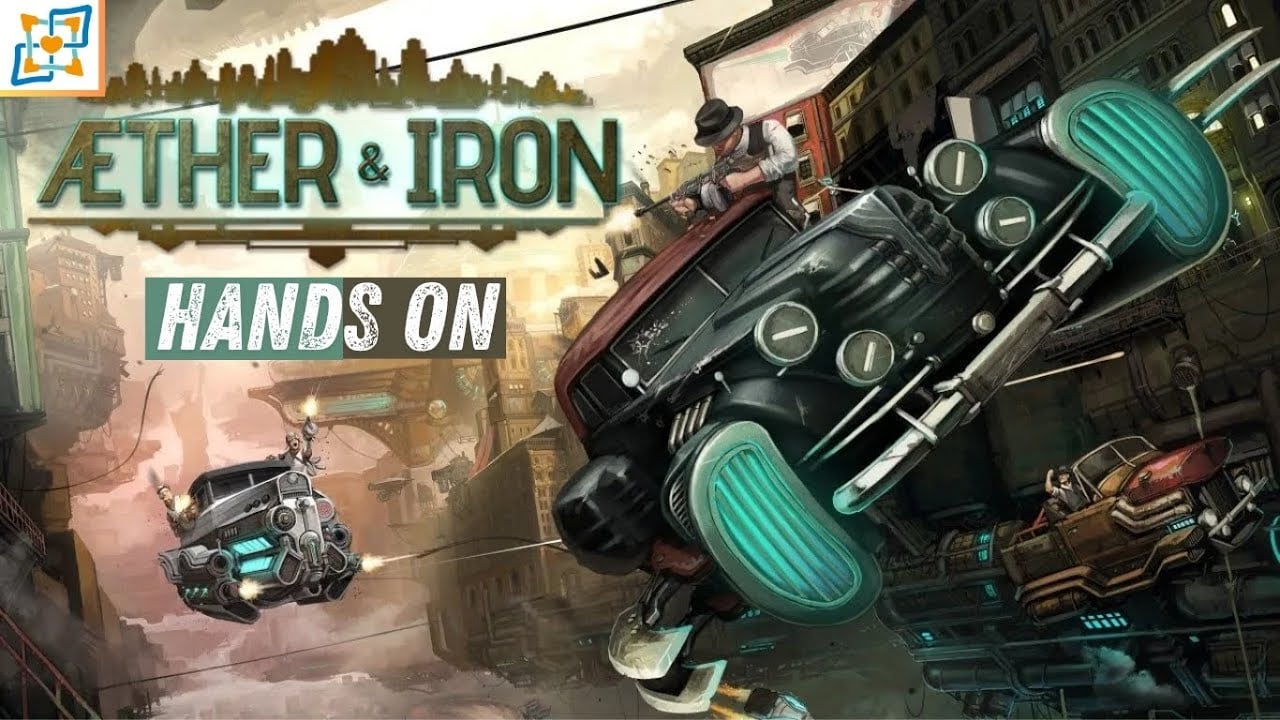


I just played the demo for Aether & Iron, a narrative RPG in development at Seismic Squirrel, and I’m going to share some details about its structure.
This is a very intriguing project that’s been showing up regularly on TBL’s pages for a while, precisely because it’s on my most-anticipated list. Its launch window is slated for 2026, but a few days ago, the developers released a demo that does a great job conveying what the final game aims to be.
My hands-on is based entirely on this demo and on everything I was able to see and test.
Table of Contents

What is Aether & Iron
I’ll start with what Aether & Iron is in broad strokes. It’s a narrative-driven RPG where you explore locations and talk to characters from a first-person perspective, while combat happens on the road from inside your vehicle.
There are plenty of quests to tackle and choices to make, often gated by your party’s skill checks, which will shape how events unfold.
You’ve got a Story Mode for players who want the narrative without combat distractions, a Standard mode with a balanced mix of story and challenge, and an Extreme mode for those who crave punishment, plus optional permadeath and a setting to curb save-scumming folks like me.
With that said, let’s dive into the details.
A New York Among the Clouds
Perhaps one of Aether & Iron’s most original elements is its setting: the streets of a 1930s New York, with one twist: those streets and skyscrapers sit among the clouds.
Thanks to anti-gravity technology, cities and districts float in the sky, but this hasn’t united people; if anything, it’s widened the gap: elite zones above, slums below, crime and smugglers in between.

You play as one of those smugglers, dreaming of one day moving up to the wealthiest, highest district of this airborne Big Apple. The story kicks off with a quest from the neighborhood boss: you’re tasked with escorting a shy scientist heading to the slums, purpose unknown, while she carries a mysterious briefcase.
From there, events take their course. To avoid spoilers, I’ll stop here, but these are the premises of the world awaiting you.
A Choice-Driven Narrative RPG
The core experience in Seismic Squirrel’s game is a role-playing title where dialogue takes center stage, never too long-winded, and your choices branch into different narrative arcs they have in store for us.
Most of the gameplay unfolds across the locations you visit, shown in first person. You have NPCs to talk to, items to uncover, and points of interest to examine in the environment.

During conversations, you always have multiple options. Sometimes you can try to force the issue, or take the diplomatic route and hope the dice help you, facing skill checks with different difficulties. Outcomes are also affected by your characters’ attributes, which can add bonuses to your rolls.
Another system that both shapes your decisions and is shaped by them is Heat. It changes how the world sees you and affects related dialogue checks.
Higher Heat also makes combat tougher since more enemies show up. I liked this a lot because it raises the stakes of everything you do. The game world remembers every single choice and can reward you or make you pay for it in later events.
As for resources, beyond Heat, you have money, which often opens doors and lets you buy things. You also need spare parts, which you use to get your vehicles back in shape after your runs across the wider world.
The Growth System
Gia, the main character, really won me over for her personality. She is tough, knows the grim world she lives in, and knows how to move within it, projecting real confidence.
As mentioned earlier, dialogue is influenced by each character’s skill tree.

Every time you level up, which happens by earning experience points from completing quests, winning fights, and passing skill checks during conversations, you can spend points across different branches.
Each branch corresponds to a personality trait that grants bonuses in dialogue and also unlocks abilities to use in combat.
The game lets you manage multiple characters, and each can add their own passive bonuses during dialogue scenes.
The Combat System and Equipment
Structurally, it is clear that Aether & Iron is meticulously crafted, and that includes its combat system, too.
Fights play out as car-on-car engagements across grid-based maps with obstacles and civilian vehicles that you need to watch for and can potentially turn to your advantage.

Each turn, you have a set number of action points to spend on movement and attacks. Moving forward consumes more points, while decelerating to line up alongside an enemy that is behind you costs fewer.
There are several skills. A side attack requires you to get alongside your target. Rear-mounted weapons require positioning one tile ahead of the enemy. You can also use a ramming ability to shove an opponent into an obstacle.
All of this is governed by the turn order bar at the top of the interface. Another nice detail is the vehicle inventory, which gives you a limited number of free slots. That would be standard enough if it ended there.
The real twist is that, in addition to the trunk where you stash repair items to fix damage and regular items, you also have hidden compartments for smuggling contraband you find while exploring and interacting with the world. In my opinion, it is a very neat touch.
Personality in Context
In Aether & Iron it is not only Gia, our main character, who has personality. Every NPC I met has something to say, and each one has a voice-over.

It is the kind of work that often gets taken for granted, yet in an RPG like this, where narrative is the main pillar, it adds that extra layer that makes the game world feel incredibly deep.
The same goes for the visual style, the 1930s noir setting you move through, and the background music, which ties everything together perfectly. The UI deserves a mention too, since I found it clean in every phase of gameplay.
My few cents
I admit I am not a fan of long blocks of text. I always prefer action over dialogue, and that was what worried me and held me back a bit with Aether & Iron. Fortunately, during this demo, everything felt enjoyable and nothing ever felt “too much.”
Expectations were high before I got my hands on it. Now they are even higher for the final release coming in 2026. In the meantime, I can only recommend trying the demo on PC via Steam.
That said, let me know if you have tried Aether & Iron and what your impressions are. Ciao
Video Preview