


From BattleTech and Front Mission to Xenogears and Super Robot Wars, these are the 20 RPGs and strategy games involving Mechs I would recommend first.
I have always thought mechs and turn-based combat were a particularly good match. Giant machines should feel heavy, expensive, complicated, and slightly terrifying to lose. A turn-based system gives you time to think about what makes them interesting: armor, heat, positioning, pilots, damaged components, and the consequences of pushing a machine too far.
That doesn’t mean every game approaches mechs the same way. Some treat them as military hardware. Others turn them into JRPG party members. A few are closer to tactical puzzles, while Xenogears and Chained Echoes move between character combat and dedicated mech systems and more.
This is not a strict ranking. My starting recommendation is BattleTech for the mercenary-company experience, or Into the Breach for concentrated tactical decisions. Front Mission Remakes are the next customization-heavy tactical RPGs I would point to. The rest depends on whether you want a workshop, an anime crossover, a roguelite, or a long character-driven adventure.
The important part is finding the type of mech game you actually want.
Find Your Next Mech Video Game
Release years refer to the editions discussed, with significant port dates and Early Access launches identified separately. Platform listings distinguish native releases from backward compatibility; regional console releases are labeled where relevant.
1. BattleTech
Mercenary management, heat control, and machines that actually feel expensive
- Developer: Harebrained Schemes
- Release: 2018
- Platforms: PC

If someone asked me to recommend just one game that captures what I want from turn-based mech combat, BattleTech would probably be my first answer.
The reason is not simply that the tactical combat is good. What makes it special for me is how much each decision reflects the fact that you are commanding enormous, expensive machines.
Armor facing, component damage, evasion, weapon range, heat, and stability all influence how a fight develops. A mech that is technically still alive may already have lost the arm carrying its main weapon. Turning a healthier side toward the enemy can keep a battered machine useful; exposing its damaged side for another turn might leave much less of it to recover.
And then the mission ends.
You still have to pay salaries, repair machines, replace equipment, develop your MechWarriors, and keep the company ready for its next contract. Negotiating for more salvage instead of immediate payment is tempting when the right parts could expand your lance, but the bills do not disappear. The MechLab ties those rewards back into combat, letting you rebuild loadouts around different weapons and battlefield roles.
I like that a successful mission does not necessarily settle the question of whether the job was worth taking. You can collect the payment and still wonder whether it covers what you lost. That relationship between tactical success and long-term consequences is the main reason I would choose BattleTech over most of the alternatives here.
It is a slower commitment than a compact tactics game. But running a mercenary company, obsessing over loadouts, and trying to bring both pilots and machines home in working order is exactly the appeal.
Links: Steam · TBL’s BattleTech review
2. Into the Breach
Three mechs, an 8×8 board, and very little room for a wasted action
- Developer: Subset Games
- Release: 2018; 2022 (mobile)
- Platforms: PC, Nintendo Switch, Android, iOS

Into the Breach is probably the game on this list that does the most with the fewest moving parts.
You control three mechs on a little 8×8 board. The situation is usually easy to read; working out what to do about it is another matter. One artillery shot, one push, and one movement action might be enough to rescue a terrible position, provided they happen in the right order.
The key is that enemy attacks are telegraphed before they happen. You can see what each Vek intends to hit, so the interesting question is how to change that outcome. Push an attacker aside, and it might shoot another Vek instead. Knock a non-flying enemy into water and you can remove it without whittling down its health. Sometimes letting a mech take damage is the sensible move because protecting a civilian building matters more.
That is the part of the design I admire most. A weapon is not necessarily valuable because of the damage number attached to it. Its ability to move something one square can solve several problems at once.
Different squads change how you approach those situations, while pilots and equipment reshape individual machines. The free Advanced Edition expands that selection with five squads, nearly forty weapons, additional enemies, mission objectives, and pilot options.
There is no mercenary payroll to manage, and it does not pursue BattleTech’s maintenance-and-salvage fantasy. I would choose it for the battlefield itself. Few games make such a convincing argument that one well-used action can matter more than a bigger army.
Links: Steam · TBL’s Into the Breach review
3. Phantom Brigade
Plan the movement, time the shot, then let both sides act
- Developer: Brace Yourself Games
- Release: 2023 (full release)
- Platforms: PC

Phantom Brigade needs a qualification: you plan in turns, but the action is not a conventional exchange of move-and-attack phases. Both sides execute their orders simultaneously.
Before committing, you can inspect the enemy’s predicted movements and attacks along a timeline, scrubbing forward to see how the situation will develop. Then you arrange your squad’s response and let the plan run.
What I find most interesting is that positioning becomes inseparable from timing. Knowing where an enemy stands now is not enough. You need to consider where it will be when your weapon fires, and where incoming fire will pass while your own mech is moving. Shields, collisions, and destructible buildings complicate that coordination further.
Between battles, you salvage equipment, refit machines, and move a mobile base through occupied territory. The substantial 2.0 update also reworked the campaign and expanded pilot development with classes and more than 100 traits and abilities combined, alongside changes to the overworld and customization.
The timeline is still the reason I would recommend it, though. It asks you to coordinate a squad’s actions down to their timing, then shows the result in motion. That is an excellent fit for giant machines whose shots, movements, and collisions should carry some weight.
Links: Steam – TBL’s Phantom Brigade Review
4. Front Mission Series
Build the Wanzer, then keep it fighting as the parts come off
- Featured games: Front Mission 1st: Remake; Front Mission 3: Remake
- Developers (featured remakes): Forever Entertainment (1st); MegaPixel Studio (3)
- Release: 2022–2023 (1st: Remake); 2025–2026 (3: Remake)
- Platforms (featured remakes): PC, Nintendo Switch, PlayStation 4, PlayStation 5, Xbox One, Xbox Series X|S
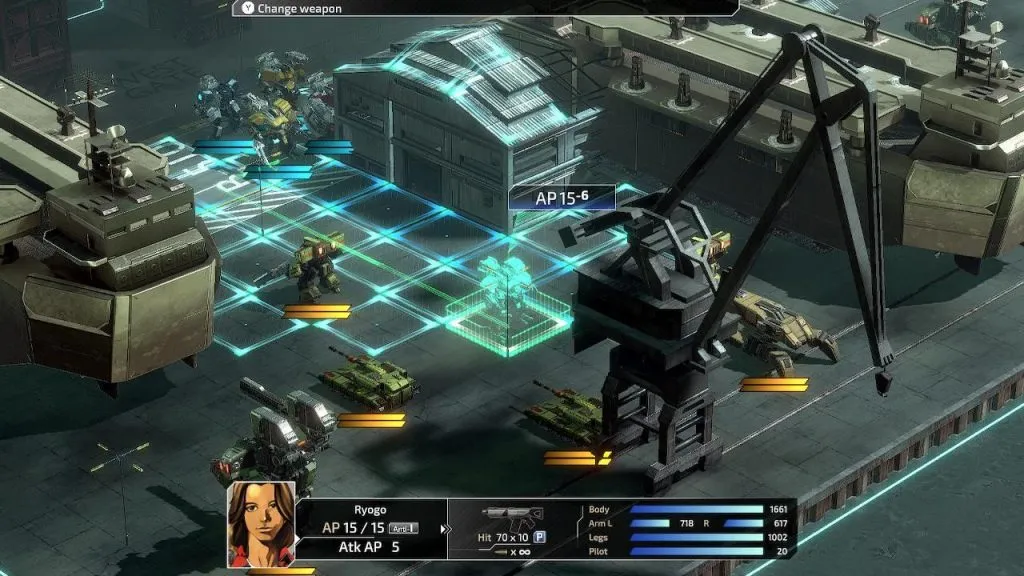
Front Mission is an easy recommendation for anyone who thinks preparing the squad should be as interesting as the battle itself.
Bodies, arms, legs, weapons, and computers all contribute to a build. Lose a weapon-bearing arm, and that attack option goes with it. Cripple the legs and movement suffers. Weight, range, and accuracy matter before deployment, but during combat the question becomes how much of the machine can still do its job.
Front Mission 3: Remake would be my starting point. Its equipment also creates opportunities to learn pilot skills, giving an otherwise weaker part a reason to stay in consideration. I like that choice: the immediate upgrade and the useful long-term investment are not always the same component. An early decision also splits the story into the Emma and Alisa routes, changing allies, missions, and your perspective on the conspiracy.
Front Mission 1st: Remake is the simpler alternative. Its O.C.U. and U.C.S. campaigns show the Huffman Island conflict from opposing sides, which is a good reason to visit the series’ foundations even with the third game available. I would choose it for that military setting and a less elaborate version of the squad-building formula.
Links: Steam
5. Super Robot Wars Y
A tactical RPG for assembling an unreasonable anime crossover team
- Developer: Bandai Namco Forge Digitals
- Release: 2025
- Platforms: PC, PlayStation 5, Nintendo Switch

The reason I would pick Super Robot Wars Y has very little to do with repair bills or replacing a damaged arm. It is the chance to put robots from completely different anime series on the same battlefield and invest far too much in a favorite pilot.
Sometimes that is exactly what I want from a mech game.
The basic structure is grid-based tactical combat: move units, choose attacks, and decide where to concentrate your strongest machines. Between missions, resources go toward improving robots and developing pilots, so choosing who deserves the next upgrade becomes part of the attraction.
Y introduces Assist Link, which gives supporting characters battlefield effects that can improve with use. The support crew becomes another part of building the force, alongside the pilots taking the main stage.
Its crossover includes Mobile Fighter G Gundam, Gundam Wing: Endless Waltz, The Witch from Mercury, Getter Robo Arc, Macross Delta, and Majestic Prince, among others. That roster is worth checking before deciding how much the game’s appeal speaks to you.
I would not make this my first recommendation for someone whose priority is relentless tactical combat. The stronger point is the pleasure of developing a team of recognizable machines and watching their signature attacks receive the full anime treatment. A mech recommendation list has room for that kind of excess.
Links: Steam
6. SD Gundam G Generation Cross Rays
Building the Gundam collection you always wanted
- Developer: TOM CREATE
- Release: 2019
- Platforms: PC; PlayStation 4 and Nintendo Switch (Japan/Asia releases)

The appeal of Cross Rays is having another mobile suit to work toward. Developing units, unlocking new machines, and deciding who gets to pilot them can be just as interesting as the next battle.
Units gain experience and develop into other models. The Design system opens additional production options, while capturing enemy machines gives you another way to expand the collection. Those systems turn a new Gundam into a goal you can plan around, instead of simply another item waiting in a shop.
The tactical battles give that growing roster somewhere to prove itself, but I recommend it for the collection and development.
One useful limitation to understand first: the main scenarios focus on Gundam Wing, SEED, 00, and Iron-Blooded Orphans, along with related stories. This is not a tour of the entire franchise.
For fans of those series, though, that focus makes sense because it recreates familiar teams, mixes pilots and machines across their original stories, or works toward a particular favorite.
Links: Steam
7. Mech Armada
Design the machines, then find out what the squad can afford
- Developer: Lioncode Games
- Release: 2022
- Platforms: PC, Nintendo Switch, PlayStation 4, PlayStation 5, Xbox One, Xbox Series X|S

Mech Armada is the recommendation I would make when designing the machines sounds like half the fun.
You assemble mechs from different bodies, movement systems, and weapons, then take those creations into turn-based battles against the Swarm. A fast weapons platform and a heavily armored front-line unit need to solve different problems, even when both look impressive in the workshop.
A powerful build still has to justify its cost, and a new part can give you a reason to rethink the squad. Spending everything on one elaborate machine is not necessarily better than fielding a group that covers each other’s weaknesses.
The game presents a roguelite structure where each run asks you to work with the equipment and opportunities available.
Links: Steam
8. Relayer Advanced
A mecha tactical RPG that thinks in traditional party roles
- Developer: Dragami Games
- Release: 2022 (Advanced edition)
- Platforms: PC

The easiest way I would describe Relayer Advanced is a traditional JRPG party sent into battle inside giant robots.
The machines dominate the screen, but the decisions revolve around jobs, character skills, positioning, and who should absorb the enemy’s attention. That last point is more explicit than in many tactical RPGs because of the Hate system.
Hate influences which character enemies are likely to target. Building around it gives tougher units a way to protect fragile teammates, instead of leaving their defensive role entirely at the mercy of enemy targeting.
Pincer attacks, called Backstabs, give tactical movement vital purpose, while Big Bang moves supply the appropriately excessive anime spectacle. That is enough to give Relayer Advanced a place here. The party-building matters more than the workshop.
Links: Steam
9. Warborn
Advance Wars-style map control with anime mechs
- Developer: Raredrop Games
- Release: 2020
- Platforms: PC, PlayStation 4, Xbox One, Nintendo Switch

Take the map control and unit roles of Advance Wars, replace the tanks and infantry with anime-style mechs, and move the battles onto hexes. That is a useful starting point for Warborn.
You capture structures, generate resources, bring in reinforcements, and use each Variable Armour unit for the job it was designed to do. The four commanders have different abilities and signature machines, but this is about directing a force across the map, not engineering every unit from individual components.
I appreciate having that option in a list where the workshop often competes with the battlefield for attention. Here, the more immediate questions are which unit to deploy, where it can contribute, and which position needs to be secured before the opposition gets there.
I would recommend Warborn to someone asking for a strategy game with mechs before someone asking for a detailed mech RPG. Its lighter approach to individual customization is part of that distinction, not something it needs to imitate BattleTech to fix.
Links: Steam – TBL’s Warborn Review
10. Ignited Steel: Mech Tactics
Overheating is dangerous, so naturally you might want to do it
- Developer: Yokaicade
- Release: 2022
- Platforms: PC

Heat management is nothing new in mech games, but Ignited Steel does something with it that I really like: overheating is not simply a problem to avoid.
Moving and attacking build heat. Once a mech overheats, it becomes more vulnerable, but it also deals more damage. Keeping everything cool is therefore not automatically the sensible choice.
Maybe the extra damage is enough to remove a dangerous enemy before it can act. Maybe the position is safe enough to accept the increased vulnerability. Get the calculation wrong, though, and that aggressive move leaves an overheated machine exposed to an opponent that benefits from the same decision.
The campaign follows a roguelite structure, with routes, pilots, modules, and three mech archetypes, Juggernaut, Stalker, and Javelin, shaping the options in each run. I would come here for that heat trade-off, not expecting a super deep mercenary simulation.
Links: Steam · TBL’s Ignited Steel review
11. NITRO GEN OMEGA
Four pilots, one mech, and a crew that has to work together
- Developer: DESTINYbit
- Release: 2025 (Early Access); 2026 (full release)
- Platforms: PC, PlayStation 5, Xbox Series X|S, Nintendo Switch

The detail I find most interesting about NITRO GEN OMEGA is how four pilots operate one mech. They work as a team, with each pilot controlling a different subsystem.
It’s not like you assign a pilot to a mech and they’re done. Each pilot has an active role in firing, dodging, and keeping their mech from overheating. This is coordinated using a timeline created during mission planning phases and executed in fast-paced animated battle scenes.
This creates value for the pilots before the game asks you to care about them. The mech’s performance relies on coordinating all the pilots’ actions.
In addition to the battle-focused gameplay, you also manage a crew of mercenaries in a world filled with rogue machines. You will have opportunities to visit settlements, take on contracts, recruit new pilots, and explore abandoned machine lairs. In-game purchases can be made using resources gained in battles to enhance your mech’s loadout; additionally, developing relationships and building up individual characters occurs on board the airship between missions.
A main storyline was introduced at launch (which coincided with adding a main quest), but it still lets players direct their crew wherever they want when completing missions.
For me, what makes NITRO GEN OMEGA such a great Mech Strategy RPG alternative is the focus on a single shared mech being operated by the entire crew.
Links: Steam – TBL’s NITRO GEN OMEGA 1.0 coverage
12. Wolfstride
Mech fighting, odd jobs, and the people keeping Cowboy running
- Developer: OTA IMON Studios
- Release: 2021 (PC); 2022 (Switch); 2023 (mobile)
- Platforms: PC, Nintendo Switch; Android and iOS through Crunchyroll Game Vault

Wolfstride stands out to me because its giant robot is not part of an army. It is a battered machine that three former partners in crime are trying to turn into a tournament contender.
That mech is Cowboy, and the competition is the Ultimate Golden God Tournament. Between fights, you repair Cowboy, replace parts, install upgrades, explore Rain City, and take odd jobs to keep the operation going. The arena battles are one-on-one turn-based duels, with movement, attacks, and defensive actions determining how the exchange develops.
I would recommend Wolfstride for more than its combat. The black-and-white presentation, strange characters, and humor give the journey a personality unlike anything else on this list.
Links: Steam · TBL’s Wolfstride review
13. STARBITES
A character-driven JRPG with customizable Motorbots
- Developer: IKINAGAMES
- Release: 2026 (Western release)
- Platforms: PC, PlayStation 5, Xbox Series X|S, Nintendo Switch, Nintendo Switch 2

STARBITES is also among the newest examples of why I think we should consider putting some older (and more modern) Japanese-style RPGs into our list rather than just listing Grid-Based Tactics Games.
Throughout your journey with Lukida and her friends, you will explore Bitter, a desert planet littered with the remnants of war and an intergalactic conflict. Your Motorbots can be used for both exploration and turn-based battles; you can upgrade their weapons and other systems to affect how they function in both modes.
One aspect of combat mechanics that I find interesting is “Driver’s High”. When you fill the high gauge you have an opportunity to perform enhanced attacks and additional actions, such as the ability to pause/stop the usual turn order.
It’s always nice that your machine (in this case the Motorbots) serves as a tool for survival and transportation while traveling through the game world, and not only for the combat.
This is the reason I would add Starbites to a fan’s list of games based upon a love of JRPGs: customization, party growth, exploration, and Motorbot travel through the world, all without requiring the structure of a tactical military campaign.
Links: Steam
14. Xenogears
A JRPG where climbing into a Gear changes the scale of the adventure
- Developer: Square
- Release: 1998
- Platforms: PlayStation (original release)

There was no realistic version of this Mech RPG list where I was leaving out Xenogears. Characters spend a significant part of the game fighting on foot, and it is an RPG first. That does not make the Gears any less important.
Moving between human combat and giant machines makes those machines feel like a distinct part of the adventure. Gear battles also have their own resource considerations. Fuel powers actions, equipment affects performance, and the combat system translates character techniques into mechanical Deathblows. Getting inside a Gear changes what you need to manage, not just the size of the enemies on screen.
Then there is everything surrounding the combat that makes Xenogears a memorable game: war, identity, religion, psychology, and a story with far more on its mind than finding the next robot to fight.
Unfortunately, you’ll need an emulator or a PlayStation to enjoy this masterpiece, but I can’t recommend it enough.
15. Chained Echoes
A modern JRPG that makes room for a second kind of party combat
- Developer: Matthias Linda / Umami Tiger
- Release: 2022
- Platforms: PC, Nintendo Switch, PlayStation 4, Xbox One

Chained Echoes earns its place here for reasons similar to Xenogears. It is not entirely about mechs, and I think that makes their arrival more interesting.
You spend a substantial part of the adventure with a conventional JRPG party. Sky Armors later become part of exploration and combat, opening up the world while giving the party another way to fight.
What I appreciate is that they are not simply larger character models with inflated health bars. Sky Armors have their own equipment, weapons, roles, and resource considerations. Access to a machine changes where you can go, so getting one feels like a change in the adventure.
I would recommend Chained Echoes to someone who wants a complete character-driven JRPG with mech combat inside it. The Sky Armors are one substantial part of the journey, and the surrounding adventure gives them a reason to feel special.
Links: Steam
16. ARC SEED
When the city becomes part of your loadout
- Developer: Massive Galaxy Studios
- Release: 2024 (Early Access); 2025 (full release)
- Platforms: PC

ARC SEED has a familiar premise: giant mechs fighting an alien invasion in the middle of palaces.
Before facing the Archangels, you can invest in defenses, upgrade your mech, choose equipment, and build a deck around the way you want to fight. Once combat begins, however, the buildings become tools too. They can block attacks and provide cover, or be moved to crush enemies.
The civilian-protection angle brings Into the Breach to mind, of course, but deckbuilding and the ability to turn buildings into weapons give ARC SEED a different set of decisions. Cards and equipment shape the mech’s options; the city determines what you can do with them.
That is why I would include it alongside the other mech roguelites. The interesting build is not confined to the machine. It also depends on what is standing around it, and whether everyone has had time to get out.
Links: Steam · TBL’s ARC SEED coverage
17. GearHead Caramel
A mecha RPG for people who want freedom more than visual presentation
- Developer: Joseph Hewitt
- Release: 2022 (Steam edition)
- Platforms: PC

GearHead Caramel is the indie deep cut I would point to when someone wants more freedom than a fixed sequence of tactical missions.
This is a turn-based mecha RPG with combat on foot and inside enormous machines. You can recruit companions, take missions, collect salvage, install components, and design mechs from scratch. The construction system goes beyond choosing which gun fits an existing weapon slot.
The rest of the RPG similarly gives the campaign room to develop. Its procedural narrative systems let events depend on the situation, NPC relationships respond to your actions, and lifepath-based character creation gives a pilot a history as well as statistics.
I find that combination more distinctive than simply adding another layer of mech upgrades. The person, their companions, and the machines all belong to the same developing campaign.
This is a game to investigate for its construction and role-playing systems, not for elaborate attack animations or a polished cinematic introduction.
Links: Steam
18. Mainframe Defenders
Four robots and a squad built around equipment interactions
- Developer: Synthetic Domain
- Release: 2020 (PC); 2021 (consoles)
- Platforms: PC, Nintendo Switch, PlayStation 4, Xbox One

Mainframe Defenders gives players robotic prototypes to control. You command four units inside a research facility overrun by hostile machines, working through procedurally assembled missions and collecting gear.
The important part is that items have effects and drawbacks. An upgrade can solve one problem while creating another, and a piece that looks unremarkable on its own can become valuable because of how it interacts with the rest of a build.
That makes the relationship between items more interesting than the search for an individually perfect weapon. I also like the computer-terminal presentation. It suits a game whose attraction is sorting through systems and finding a useful combination.
Links: Steam
19. ACE Strategy: Mecha Nova
Deckbuilding with a 3×3 formation to think about
- Developer: EMINA STUDIO
- Release: 2026
- Platforms: PC

Let’s close the list of the best Mech RPG and strategy games available with ACE Strategy: Mecha Nova. An interesting game that mixes together grid-based combat with mechs and cards.
The 3×3 grid gives you nine spaces to work with around the main mech. Cards can issue commands, deploy drones, and trigger effects, while the arrangement of units helps activate circuit abilities.
During a run, new cards, Chips, and route choices gradually shape the build. The cards determine the actions available, while upgrades and formation choices influence what the machine can do with them.
That is the reason I would put it beside the other mech roguelites. It gives a card-based game a spatial problem without asking for the scale of a full battlefield campaign. I would choose it for the interaction between hand, formation, and upgrades. Anyone expecting a detailed mercenary simulation should look elsewhere.
Links: Steam · TBL’s ACE Strategy coverage
20. Death Ring: Second Impact
Build the squad around equipment synergies and changing objectives
- Developer: Rouge Mecha
- Release: 2025 (Early Access)
- Platforms: PC

Let’s close the list of the best Mech RPG and strategy games available with Death Ring: Second Impact. Even if in early access, I think that this strategy roguelite RPG fits very well here.
Different loadouts change a mech’s role, and particular combinations unlock Synergy Skills. With a large selection of modules to work through, the goal is not simply finding an upgrade for every slot, but making those choices work together across the squad.
The objectives help give that preparation a purpose. Missions include evacuation, defense, mining, and targeted operations, so wiping out every enemy is not always the only consideration. A build has to contribute to the task at hand.
I would keep the Early Access caveat in mind before choosing it over a finished campaign. But for someone interested in modules, equipment synergies, and adapting a mech squad between runs, it is a relevant addition to the list.
Links: Steam · TBL’s Death Ring: Second Impact overview
Honorable Mentions and Upcoming Turn-Based Mech RPGs
Before wrapping up, Ring of Red deserves a mention, a PlayStation 2 gem that not everyone may know about. There are also the other Super Robot Wars entries, but I chose Super Robot Wars Y to represent the franchise as a whole. Bonaparte – A Mechanized Revolution also fits the list, with its massive steam-powered robots.
Looking ahead, there are several promising mech-focused strategy games in development. Tyrant Tactics is another Advance Wars-style title mixing infantry and robotic units, while Kriegsfront Tactics draws heavily from Front Mission, although updates on its development have been scarce lately.
There’s also the PSX-inspired mecha JRPG Lie of Caelum: Spirit, currently running a Kickstarter campaign, and Muv-Luv: Tactics Kalidasa at Nightmare, a mix of visual novel and tactical RPG starring giant robots. Frost Protocol is another one to watch, combining an XCOM-style strategy layer with tactical missions built around robotic exploration units.
There’s clearly more on the horizon, so I may return to these upcoming games in a future list. In the meantime, let me know what you think through my social channels or over on the Reddit community, which is closing in on 10,000 members.

